Chin Advancement Surgery: Small Change, Major Difference
There are actually many different types of chin surgery.
Common examples include:
advancement
setback
narrowing
vertical lengthening
vertical reduction
In reality, multiple factors are often adjusted simultaneously while considering:
overall facial proportion,
chin shape,
mandibular projection,
and the relationship between the lips and chin.
Among these procedures, today I would like to talk about one of the surgeries with the highest patient satisfaction in my facial contouring practice: chin advancement surgery.
Especially in male patients, this procedure often creates a significant improvement in facial impression while maintaining a very high satisfaction rate.
Why Is the Chin Important?
The chin is one of the key structural components of the lower face.
When chin projection is insufficient:
the side profile may appear flat,
the jawline and neck transition can become less defined,
the lips may appear relatively protrusive,
and the overall facial structure may look weaker.
On the other hand, appropriate chin projection can:
create a sharper jawline,
improve facial balance,
and produce a much more refined side profile.
Particularly in male faces, proper chin projection can have a major impact on overall facial impression.
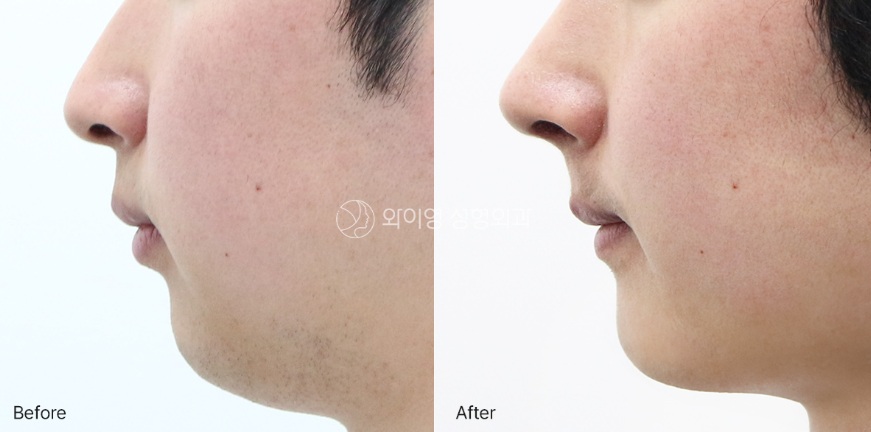
In many cases, chin advancement surgery does not simply move the chin forward. It also helps define the mandibular line and cervicomental angle more clearly, improving the overall side profile balance.
Before and after chin advancement surgery demonstrating improved chin projection and more balanced side profile.
How Is Chin Advancement Surgery Performed?
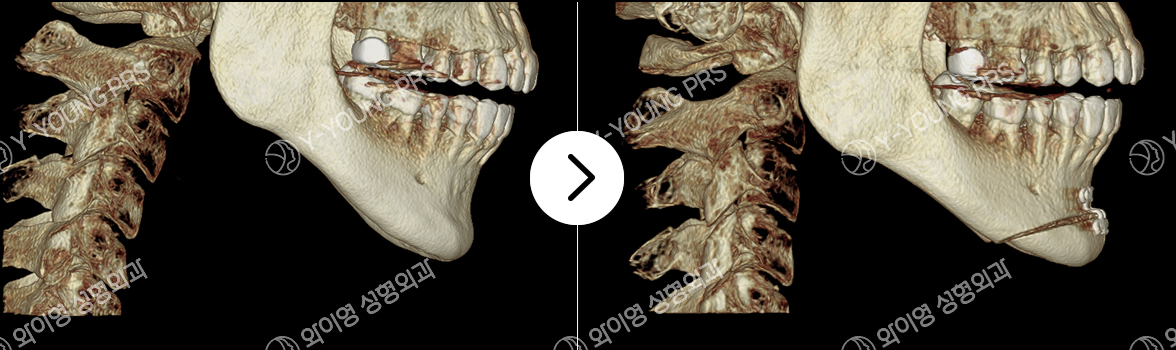
Chin advancement surgery basically involves osteotomizing the chin segment, advancing it forward, and stabilizing it in a new position.
In most cases, this is performed using a T-genioplasty technique.
After the chin segment is advanced to the desired position, it is securely fixed using titanium plates and screws.
3D CT comparison before and after chin advancement surgery demonstrating forward repositioning of the chin segment.
It Is Not Always Just “T-Genioplasty”
Many patients are familiar with the term “T-genioplasty.”
However, in actual surgery, the osteotomy design can be modified depending on the patient’s chin shape and aesthetic goals.
Examples include:
‘T’ osteotomy
‘ㅅ’ osteotomy
‘W’ osteotomy
Different osteotomy patterns may be used when:
greater narrowing is desired,
a softer chin shape is needed,
asymmetry correction is necessary,
or vertical height adjustment is required.
In other words, what matters most is not simply the name of the osteotomy technique, but how the chin is moved and designed according to the patient’s facial structure.
The Key to Chin Advancement Surgery Is Natural Balance
Chin advancement surgery is not about pushing the chin excessively forward.
Over-advancement may result in:
an artificial side profile,
an unnatural lip-chin relationship,
or an overly strong facial impression.
Ultimately, the goal is to create appropriate projection and harmony within the overall facial balance.
Especially when the:
nasal tip,
lips,
chin,
and jawline
connect naturally with one another, the side profile appears much more refined and harmonious.
A Small Change That Can Create a Major Difference
Although chin advancement surgery is considered a relatively straightforward facial contouring procedure, the change in facial impression and patient satisfaction can often be surprisingly significant.
Especially in patients with:
a weak chin,
a soft side profile,
a poorly defined jawline,
or relatively protrusive lips,
appropriate chin advancement alone can greatly improve overall facial balance.