For many Asian patients considering rhinoplasty, one question comes up repeatedly:
“My nose bridge is very low. Can I still make it higher without a silicone implant?”
The short answer is: in selected patients, yes.
A low nasal bridge does not automatically mean that a silicone implant is necessary. At Y-Young Plastic Surgery in Seoul, Dr. Kim Hye-young performs implant-free rhinoplasty using the patient’s own cartilage when the anatomy and desired result make this approach appropriate.
However, building a nasal bridge without an implant is not simply a matter of replacing silicone with cartilage. The material behaves differently, and the surgical plan needs to account for the entire nose—from the bridge to the tip.

Clinical Case: Significant Bridge Augmentation Without Silicone
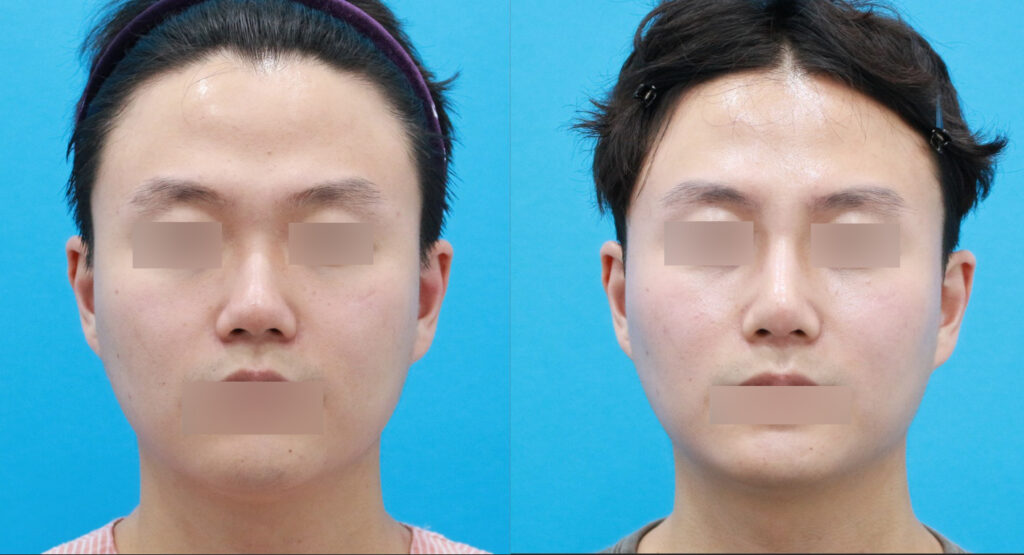
This patient had a very low nasal bridge with relatively limited tip projection before surgery. His main concern was whether meaningful bridge augmentation could be achieved without using a silicone implant.
In this case, implant-free rhinoplasty was performed using autologous cartilage. The goal was not only to increase the height of the nasal bridge, but also to establish sufficient structural support at the tip so that the bridge and tip could form a balanced profile.
As seen in the postoperative profile, substantial dorsal augmentation was achieved without a silicone implant. The 45-degree and frontal views also demonstrate why bridge height should not be evaluated in isolation: increasing projection while maintaining appropriate nasal width and overall facial balance was an important part of the surgical design.
No silicone implant was used in this case.
Dr. Kim’s Note
“Patients sometimes assume that a very low bridge automatically means that silicone is necessary. This case demonstrates that this is not always true. With sufficient autologous cartilage and appropriate structural design, substantial augmentation can be possible without a synthetic implant. However, the achievable height and shape are different for every patient.”
Why Is Silicone Commonly Used for a Low Asian Nose?
Many Asian patients naturally have a relatively low nasal bridge combined with limited tip projection.
Silicone implants are commonly used because they can create a smooth, predictable increase in bridge height. They can also be shaped relatively precisely.
For some patients, this is a perfectly reasonable option.
But others specifically want to avoid a synthetic implant because they are concerned about having a permanent foreign material in the nose, or because they have already experienced problems with a previous implant.
The question then becomes:
Can enough height be created using only the patient’s own tissue?
In some noses, it can.
How Can the Nasal Bridge Be Raised Without Silicone?
For meaningful augmentation of a low bridge, a sufficient amount of cartilage is required.
At Y-Young, autologous rib cartilage may be used when substantial structural support or augmentation is needed. The cartilage is harvested from the patient’s own rib and can be used for both the nasal framework and the bridge.
For the bridge, cartilage can be prepared and shaped to create a continuous dorsal contour rather than simply placing a prefabricated synthetic implant over the nasal bones.
This allows us to use the patient’s own tissue to build both height and structure.
The goal is not merely to make the bridge higher. The new bridge needs to connect naturally with the forehead, nasal tip, and overall facial proportions.

A Very Low Bridge Does Not Always Require an Implant
One common misconception is that implant-free rhinoplasty is only suitable for patients who already have a reasonably high bridge.
That is not always the case.
I have performed no-implant rhinoplasty in patients who started with a distinctly low nasal bridge and wanted a meaningful increase in height.
The important question is not simply:
“Is the original nose low?”
Instead, I evaluate:
- how much augmentation the patient wants
- the amount and quality of available cartilage
- skin thickness
- the existing nasal framework
- tip projection and support
- previous rhinoplasty or filler procedures
- the patient’s tolerance for the characteristics of cartilage-based augmentation
A very low nose can sometimes be raised substantially without silicone, but not every nose should be treated in exactly the same way.
The Tip Is Just as Important as the Bridge
This is particularly important in Asian rhinoplasty.
If we only increase the height of the bridge while leaving a short or under-projected tip unchanged, the nose can look unnatural or unbalanced.
For this reason, I usually think about the bridge and tip together.
Autologous rib cartilage provides strong structural support and can be useful for increasing tip projection, supporting a weak nasal framework, and creating a more defined nasal shape.
The final result depends on the relationship between:
bridge height + tip projection + tip rotation + skin thickness + facial proportions.
This is why I do not consider implant-free rhinoplasty simply a “silicone-free bridge procedure.”
It is a structural rhinoplasty.
What About a Low Bridge With a Bulbous Tip?
This is another common combination among Asian patients.
A patient may have:
- a low bridge
- a wide or bulbous nasal tip
- thick skin
- weak tip cartilage
Simply making the bridge higher does not necessarily make this nose look refined.
In these patients, the surgical plan may need to improve tip support and projection while creating an appropriate bridge height.
Thick skin is particularly important because even a well-constructed cartilage framework may not appear sharply defined if the overlying soft tissue is very thick.
For this reason, patients with thick skin and a bulbous tip need realistic expectations about how much visible definition can be achieved.
Does a Cartilage Bridge Feel or Look Different From Silicone?
Yes.
Silicone and cartilage are different materials, and patients should understand this before choosing between them.
A silicone implant can create a very smooth and precisely controlled dorsal line.
Cartilage is living biological tissue. During healing, cartilage-based augmentation can undergo remodeling, and a small degree of absorption or contour change may occur.
Depending on the technique and the individual healing process, subtle irregularities may also be more noticeable than with a smooth synthetic implant.
For patients whose highest priority is an extremely straight, smooth and sharply defined bridge line, silicone may sometimes be the more predictable option.
On the other hand, some patients prefer the idea of building the nose entirely with autologous tissue even if that means accepting these characteristics.
Neither approach is automatically better. The right choice depends on the patient’s anatomy and priorities.
How High Can a Nose Be Raised Without an Implant?
There is no single number that applies to every patient.
The possible amount of augmentation depends on the available cartilage, skin envelope, existing nasal anatomy, and the overall surgical design.
Trying to create excessive height simply because enough cartilage is available is not necessarily desirable.
The bridge must remain proportional to the forehead and tip, and the skin must be able to accommodate the new framework safely.
My goal is therefore not to create the “highest possible nose.”
It is to create as much appropriate augmentation as the individual nose can safely and naturally support.
Who May Be a Good Candidate?
No-implant rhinoplasty may be considered for patients who:
- have a low or flat nasal bridge
- want to avoid silicone or other synthetic implants
- need stronger tip support
- are comfortable using autologous cartilage
- understand that cartilage and silicone have different characteristics
- have realistic expectations about height and definition
It can also be particularly useful in certain revision cases where a previous implant needs to be removed and the nasal framework needs to be reconstructed.
However, implant-free rhinoplasty is not automatically the best option for every patient simply because it avoids a foreign material.
Dr. Kim’s Approach
When a patient tells me, “I don’t want silicone,” I do not begin by deciding how to replace the silicone.
I first ask what kind of nose the patient actually wants.
If the desired bridge height and tip shape can be created appropriately with autologous tissue, implant-free rhinoplasty can be an excellent option.
But if a patient wants an extremely smooth and sharply defined dorsal line, I also explain honestly that silicone has advantages that cartilage does not perfectly reproduce.
The goal should not be to avoid an implant at all costs.
The goal is to choose the material and technique that best fit the patient’s anatomy, desired result, and priorities.
Frequently Asked Questions
Can a very flat nose be made higher without a silicone implant?
Yes, in selected patients. A very low nasal bridge does not automatically require silicone. Autologous cartilage, particularly rib cartilage when sufficient volume and structural support are needed, can be used to increase bridge height while also supporting the nasal tip.
However, the amount of augmentation that can be achieved depends on the patient’s anatomy, skin thickness, available cartilage, and desired nasal shape. No-implant rhinoplasty should therefore be planned individually rather than using the same technique for every low nose.
Is rib cartilage better than silicone for a low Asian nose?
Neither material is universally better.
Silicone can provide a smooth and predictable dorsal contour and may be appropriate for patients who prioritize a very straight, sharply defined bridge. Autologous rib cartilage avoids a synthetic implant and provides strong structural support, making it useful when both bridge augmentation and tip reconstruction are required.
The choice should depend on the patient’s nasal anatomy, previous surgery, desired result, and personal preference regarding synthetic implants.
Will a nose made with rib cartilage stay high permanently?
Rib cartilage provides strong structural support, but cartilage is biological tissue and does not behave exactly like a silicone implant. Some remodeling or partial absorption can occur during healing, and the final contour may change subtly over time.
For this reason, the goal of implant-free rhinoplasty is not simply to create the maximum possible height. The bridge and tip should be constructed with long-term stability, skin tension, and overall facial proportions in mind.
Considering No-Implant Rhinoplasty in Korea?
If you have a very low nasal bridge and are wondering whether rhinoplasty without silicone is possible, the answer depends on more than bridge height alone.
Photos can provide an initial impression, but an in-person examination is important for evaluating skin thickness, nasal structure, septal cartilage, previous procedures, and the amount of augmentation that may be appropriate.
At Y-Young Plastic Surgery, each rhinoplasty plan is designed individually by Dr. Kim Hye-young based on the patient’s anatomy and desired result.
Related Articles

