No implant rhinoplasty for thick skin is possible, but thick skin changes the way I design the nose underneath.
One of the most common concerns I hear from patients with a bulbous nose is:
“My nasal skin is thick. Can my tip actually become more defined after rhinoplasty?”
The answer is yes—but the goal and surgical strategy need to be realistic.
In patients with thicker nasal skin, simply making the cartilage underneath smaller or narrower does not necessarily create a visibly sharper tip. The skin and soft-tissue envelope can mask the shape of the underlying framework.
For this reason, I often think about thick-skin rhinoplasty in the opposite way: rather than aggressively reducing the framework, I need to create enough structural support, projection, and definition underneath the skin for an appropriate amount of shape to remain visible externally.
This becomes particularly important when performing no-implant rhinoplasty using autologous cartilage.
Why Does Thick Skin Make a Bulbous Nose Look Less Defined?
A bulbous nose is not caused by one single anatomical feature.
The appearance may result from a combination of broad or weak lower lateral cartilages, limited tip projection, soft-tissue thickness, sebaceous skin, and the relationship between the bridge and nasal tip.
In patients with relatively thin skin, even small changes to the underlying cartilage can become visible externally.
With thicker skin, the situation is different.
Imagine placing a thin sheet over a structure versus placing a thick blanket over it. The same underlying shape will appear softer and less sharply defined through the thicker covering.
The nasal skin works in a similar way.
This is why I do not promise patients with thick skin an extremely sharp or tiny nasal tip. The underlying framework can be changed substantially, but not every millimeter of that change will be visible through the skin.
That does not mean meaningful improvement is impossible.
It means the surgery has to be designed differently.
Does a Bulbous Nose Need Silicone to Look More Defined?
No.
A silicone implant primarily changes the contour and height of the nasal dorsum. It does not, by itself, solve the structural reasons why a nasal tip appears broad, weak, or poorly projected.
For a bulbous tip, I pay particular attention to the structure underneath the skin.
If the existing tip cartilages are weak and the skin envelope is relatively heavy, simply narrowing the native cartilage may actually reduce support rather than create better definition.
In selected patients, autologous rib cartilage can provide the strength needed to establish a more stable tip framework and increase projection.
The nasal bridge can also be augmented without silicone when appropriate.
This is why no implant rhinoplasty for thick skin should not be thought of simply as “rhinoplasty without silicone.” The more important question is how the entire nasal structure can be designed to work with the patient’s skin thickness.
Thick Skin Sometimes Requires a More Defined Internal Framework
This is one of the most important concepts I explain to my thick-skinned patients.
The shape I create underneath the skin is not necessarily identical to the shape I expect to see externally.
If the skin envelope is thick, some of the definition of the cartilage framework will be softened once the skin is redraped over it.
Therefore, in selected cases, I may design the internal tip framework with somewhat stronger projection and sharper definition than the external appearance I ultimately want.
This does not mean that the goal is to make the patient’s nose look unnaturally pointed.
It is the opposite.
The purpose of creating a sufficiently defined internal structure is to allow a natural degree of definition to remain visible after that structure is covered by thicker skin and soft tissue.
At the same time, there is a limit.
Making the cartilage framework increasingly narrow or sharp does not mean that the external nose will continue becoming sharper. Excessively aggressive manipulation can introduce other problems without producing the expected visual benefit.
Understanding that balance is particularly important in thick-skin rhinoplasty.
Clinical Case: No-Implant Rhinoplasty for Thick Skin and a Bulbous Tip
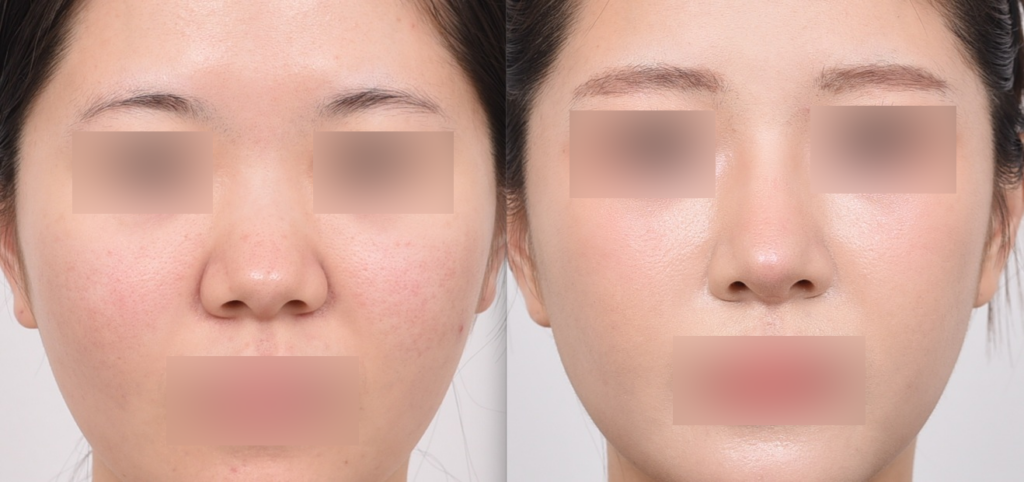
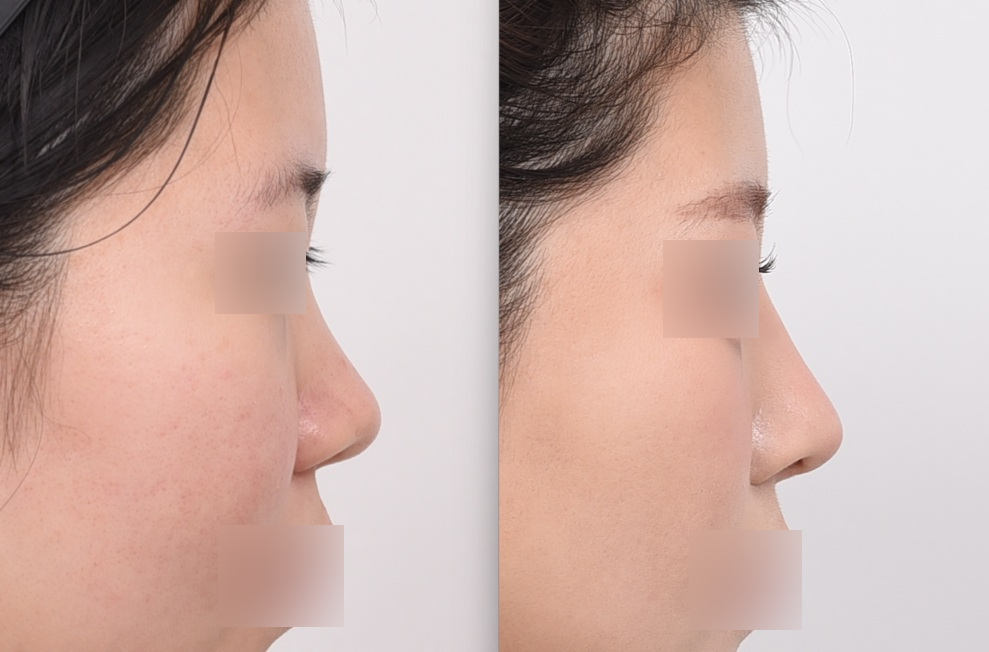
This patient had a relatively thick nasal skin envelope, a broad and poorly defined nasal tip, and limited tip projection.
Because her thicker skin softened the appearance of the structures underneath, my surgical goal was not simply to make the tip smaller.
Instead, I wanted to create a sufficiently strong and defined framework underneath the skin.
Only the patient’s own autologous rib cartilage was used. No silicone implant or donor cartilage was used.
Autologous rib cartilage provided the structural strength needed to establish tip projection and support. For the nasal bridge, diced autologous rib cartilage was used to create dorsal augmentation without a silicone implant.
Because of the thickness of the skin envelope, I designed the underlying framework with somewhat stronger definition than the external result I ultimately wanted to see.
Six Months After Surgery
At six months after surgery, the frontal view shows improved tip definition while maintaining a natural width.
The tip does not appear excessively narrow or pinched.
In the lateral view, tip projection has increased and the relationship between the bridge and tip is more balanced. The increased projection also allows the tip contour to become more visible despite the relatively thick skin envelope.
This case illustrates an important principle:
The goal in thick-skin rhinoplasty is not necessarily to create a “sharp nose.” It is to build enough definition underneath the skin so that an appropriate amount of definition remains visible externally.
Individual results vary according to anatomy, skin thickness, healing, and surgical goals.
Why I Used Autologous Rib Cartilage in This Case
Rib cartilage is not necessary for every rhinoplasty patient.
However, when I need substantial structural support, it provides considerably more cartilage than is usually available from the ear or nasal septum.
This can be particularly useful when the surgical plan requires both tip reconstruction and dorsal augmentation.
In this patient, the goal was not simply to add material to the bridge.
The tip needed enough structural strength to maintain projection underneath a relatively thick skin envelope.
Autologous rib cartilage allowed me to design the tip framework while also providing cartilage for the bridge, without using a silicone implant.
Importantly, using rib cartilage does not automatically guarantee a more defined result.
The material itself is only one part of the surgery.
How the framework is designed for the individual patient’s skin, anatomy, and desired result is more important than simply choosing rib cartilage.
Can Thick Skin Become Thin After Rhinoplasty?
Rhinoplasty does not fundamentally change a naturally thick skin envelope into thin skin.
Some soft-tissue management may be appropriate in selected patients, but aggressive thinning of the nasal skin is not something that should be pursued simply to obtain a sharper result.
The blood supply to the nasal skin is important for safe healing.
Therefore, my approach is generally to respect the characteristics of the skin and design the underlying framework accordingly rather than trying to force thick skin to behave like thin skin.
This is also why patients with thicker skin need different expectations.
A well-supported and well-projected tip can become significantly more defined, but it may never display every contour of the underlying cartilage as clearly as a thin-skinned nose.
Does Thick Skin Take Longer to Show the Final Result?
Often, yes.
Thicker skin can retain swelling for longer, particularly around the nasal tip and supratip area.
During the early postoperative period, a patient may even feel that the tip still looks round despite significant changes to the cartilage underneath.
This does not necessarily mean that the structural changes were insufficient.
As swelling gradually decreases and the soft tissues adapt to the new framework, definition can continue to improve.
The speed of this process varies considerably between patients.
For this reason, I am cautious about judging the final tip definition too early in patients with thick skin.
The six-month result shown in this article is a useful intermediate-to-later postoperative view, but rhinoplasty tissues can continue to change beyond this point.
Is No-Implant Rhinoplasty Better for Thick Skin?
Not necessarily.
I do not recommend no-implant rhinoplasty simply because it sounds more natural or because synthetic implants should always be avoided.
Silicone has advantages. It can provide a smooth and predictable dorsal contour, and it remains a reasonable option for appropriately selected patients.
Autologous cartilage also has its own characteristics. Cartilage is biological tissue and can remodel during healing. Depending on the technique and individual healing response, some absorption or subtle contour irregularity can occur.
Therefore, the choice should not be framed as:
“Which material is always better?”
A better question is:
“Which surgical plan best fits this patient’s anatomy, skin thickness, desired shape, and priorities?”
For patients who specifically prefer to avoid a synthetic implant and have an anatomy suitable for autologous reconstruction, no-implant rhinoplasty can be an option.
What If I Have Both Thick Skin and a Very Low Bridge?
These two features frequently occur together in Asian rhinoplasty patients.
A very low bridge does not automatically mean that silicone must be used. In selected patients, substantial dorsal augmentation can be created using autologous cartilage.
However, bridge height should not be considered separately from the tip.
If the bridge is significantly raised while the tip remains weak and under-projected, the nose can become unbalanced.
Conversely, strong tip projection without an appropriate bridge can also look disproportionate.
This is why I plan the bridge and tip as a single structural unit.
For a detailed example of significant bridge augmentation without silicone, see our Very Low Asian Nose No-Implant Rhinoplasty case.
Who May Be a Candidate for No Implant Rhinoplasty for Thick Skin?
Patients may consider this approach if they have relatively thick nasal skin and a poorly defined or bulbous tip, particularly when tip support is weak or projection is limited.
It may also be considered when a patient wants bridge augmentation but prefers to avoid a silicone implant and is comfortable with using autologous rib cartilage.
However, the decision cannot be made from skin thickness alone.
I also evaluate the existing cartilage framework, septal support, bridge height, tip position, previous surgery or filler, facial proportions, and—most importantly—the type of result the patient wants.
Some patients want dramatic projection. Others want only subtle refinement.
The same operation should not be applied to both.
Dr. Kim’s Approach to Thick-Skin Rhinoplasty
When I examine a patient with thick skin, I try to distinguish between what I am constructing underneath the skin and what I expect to become visible outside.
That distinction is important.
If I design the underlying cartilage only according to the external shape I want, the final result may appear less defined once the thicker skin covers it.
On the other hand, aggressively making the framework narrower and sharper has limits and can create an unnatural structure without necessarily producing a correspondingly sharp external result.
My goal is therefore to create enough projection, strength, and definition underneath the skin while preserving a natural external appearance.
In this case, the six-month result demonstrates that a bulbous tip with relatively thick skin can become more defined without needing to look excessively narrow or artificial.
— Dr. Kim Hye-young
Plastic Surgeon
Y-Young Plastic Surgery
Seoul, Korea
Frequently Asked Questions
Can no-implant rhinoplasty work if I have very thick skin?
Yes, no implant rhinoplasty for thick skin can be considered in selected patients. However, thicker skin can mask the shape of the underlying cartilage, so sufficient structural support and tip projection become particularly important. The degree of visible definition that can be achieved varies according to skin thickness, cartilage structure, swelling, and individual healing.
Does silicone make a bulbous nose tip more defined?
Not by itself. Silicone is primarily used to augment the nasal bridge. A bulbous or poorly defined tip usually requires evaluation of the tip cartilage, structural support, projection, skin thickness, and soft tissue. Increasing bridge height alone does not necessarily make a broad nasal tip more defined.
Is rib cartilage good for a bulbous nose with thick skin?
Autologous rib cartilage can be useful when strong structural support or substantial cartilage volume is required. In thick-skinned patients with weak tip support, it can help create a stable framework and improve projection. However, rib cartilage is not necessary for every bulbous nose, and the appropriate material depends on the individual anatomy and surgical goals.
Considering No-Implant Rhinoplasty for Thick Skin in Korea?
Thick skin does not automatically prevent meaningful improvement of a bulbous nasal tip, and it does not automatically mean that a silicone implant is required.
What changes is the surgical strategy.
For patients considering no implant rhinoplasty for thick skin, the relationship between skin thickness, underlying cartilage strength, tip projection, bridge height, and desired definition should all be evaluated together.
At Y-Young Plastic Surgery in Seoul, Dr. Kim Hye-young designs each rhinoplasty individually based on the patient’s anatomy and desired result.
Related reading

