Considering No-Implant Rhinoplasty in Korea?
International patients can send photos for an online consultation to find out whether an implant-free approach may be suitable for their nose.
REQUEST AN ONLINE CONSULTATION →
No-implant rhinoplasty in Korea has traditionally been considered most suitable for patients who already have a reasonably high nasal bridge.
A patient with a dorsal hump, for example, might not need additional bridge height. The existing nasal framework could be reshaped, and cartilage could be used to refine the tip or adjust specific areas without placing a silicone implant.
For patients with a very low nasal bridge, however, silicone was traditionally a much more practical way to create substantial height.
In my practice, this distinction has changed.
With advances in cartilage preparation and structural rhinoplasty techniques, I can now create meaningful dorsal augmentation without silicone in selected patients — even when the original nose is quite low.
This does not mean that I believe no-implant rhinoplasty is always better than silicone rhinoplasty.
I perform both.
The more important question is not simply whether an implant should be used, but which material can create the contour, structural support, and long-term result that best matches the individual patient.
What Is No-Implant Rhinoplasty in Korea?
No-implant rhinoplasty generally refers to rhinoplasty in which a synthetic implant such as silicone is not used to build the nasal bridge.
Instead, the patient’s own cartilage can be used to create the necessary structure and volume.
Depending on the anatomy and the amount of augmentation required, available cartilage may come from the nasal septum or, when a larger and stronger source of cartilage is necessary, from the patient’s own rib.
I prepare and shape the cartilage according to the amount of dorsal augmentation and structural support required for that particular nose.
The goal is not simply to avoid silicone.
The goal is to reconstruct the nose with enough support while creating a shape that suits the patient’s facial proportions.
Does No-Implant Rhinoplasty Work for a Low Nose?
Yes — in selected patients.
This is one of the areas where my approach has changed considerably over the years.
Previously, my basic decision was relatively simple.
If the patient already had sufficient bridge height and mainly needed a change in contour, no-implant rhinoplasty was an attractive option.
If the nasal bridge needed to be raised substantially, silicone was often the more predictable choice.
Today, a naturally low nasal bridge does not automatically mean that a silicone implant is necessary.
With the cartilage techniques I currently use, substantial dorsal augmentation can be achieved without silicone in appropriately selected patients.
I have performed implant-free rhinoplasty in women and men who originally had quite low nasal bridges, as well as in patients with bulbous noses and patients who already had relatively high noses or dorsal humps.
The indication has therefore become much broader than it used to be.
But being technically able to perform a rhinoplasty without silicone does not necessarily mean that I should recommend it to every patient.
There is another important consideration: what kind of nasal contour does the patient actually want?
The Difference Is Not Just the Material — It Is the Contour
This is something I discuss carefully with patients who are deciding between silicone and no-implant rhinoplasty.
A solid silicone implant can create a very smooth and controlled dorsal surface.
Cartilage behaves differently.
In implant-free rhinoplasty, the patient’s own cartilage is carefully prepared and shaped into a cohesive graft to create the required dorsal volume.
Because cartilage is biological tissue rather than a solid synthetic implant, some degree of remodeling or absorption can occur during healing. The final surface may also develop subtle variations rather than remaining completely uniform.
I do not necessarily consider these subtle variations undesirable.
Look carefully at a natural nose.
The nasal dorsum is rarely one perfectly straight, uninterrupted surface. There are subtle transitions between the nasal bones, the upper cartilaginous portion of the nose, and the lower cartilaginous framework.
These small changes in contour can contribute to the three-dimensional character of a natural nose.
For a patient who wants a clearly defined nasal tip while maintaining subtle, natural transitions along the bridge, I often find implant-free rhinoplasty very attractive.
Does That Mean Silicone Rhinoplasty Looks Unnatural?
No.
I think this distinction is important.
I do not divide rhinoplasty into:
autologous cartilage = natural
and
silicone = artificial.
Modern silicone rhinoplasty can look very natural when the implant is properly selected and designed.
In particular, customized 3D silicone technology gives us considerably more control over the shape of the implant than conventional standardized implants.
The bridge does not necessarily have to begin too high near the radix. The implant can be designed according to the patient’s existing anatomy, facial proportions, and desired dorsal contour.
Even subtle characteristics such as a gentle dorsal profile can be incorporated into the design.
For some patients, this ability to create a smooth and precisely controlled dorsal contour is an advantage.
When I May Prefer Silicone
There are patients for whom I still prefer silicone even though an implant-free operation may technically be possible.
One important reason is the desired surface contour.
If a patient tells me:
“I want my nasal bridge to look very smooth.”
I may recommend silicone.
A customized implant provides a stable, continuous surface and allows precise control over the dorsal line.
This can also be useful in selected patients with a crooked nose.
Correcting a crooked nose is not simply a matter of placing an implant over the deviation. The underlying septum and nasal framework must be properly evaluated and corrected when necessary.
However, in certain cases, a customized 3D silicone implant can help control the final external dorsal contour because its shape is less influenced by small irregularities in the underlying cartilage and soft tissue.
Therefore, silicone remains a useful material in my rhinoplasty practice.
The fact that I can now create considerable height without an implant does not mean that I have stopped using implants.
It means that I have more options.
When I May Prefer No-Implant Rhinoplasty
There are several situations in which I may favor an implant-free approach.
Some patients simply do not want a permanent synthetic implant inside their nose.
This preference is particularly understandable in patients who are concerned about long-term implant-related complications.
Silicone implants have been used successfully in Asian rhinoplasty for many years, but as with any implanted foreign material, complications such as infection, displacement, skin thinning, visibility, or extrusion can occur.
Using the patient’s own cartilage avoids the risks that are specifically associated with maintaining a permanent synthetic nasal implant.
However, this does not mean that autologous cartilage is complication-free.
Cartilage can remodel, partially absorb, warp, or produce subtle contour irregularities during healing. Infection and other surgical complications are also still possible.
For this reason, I explain the trade-off rather than simply telling patients that one material is safer or better.
Case 1 — No-Implant Rhinoplasty After Previous Implant Problems
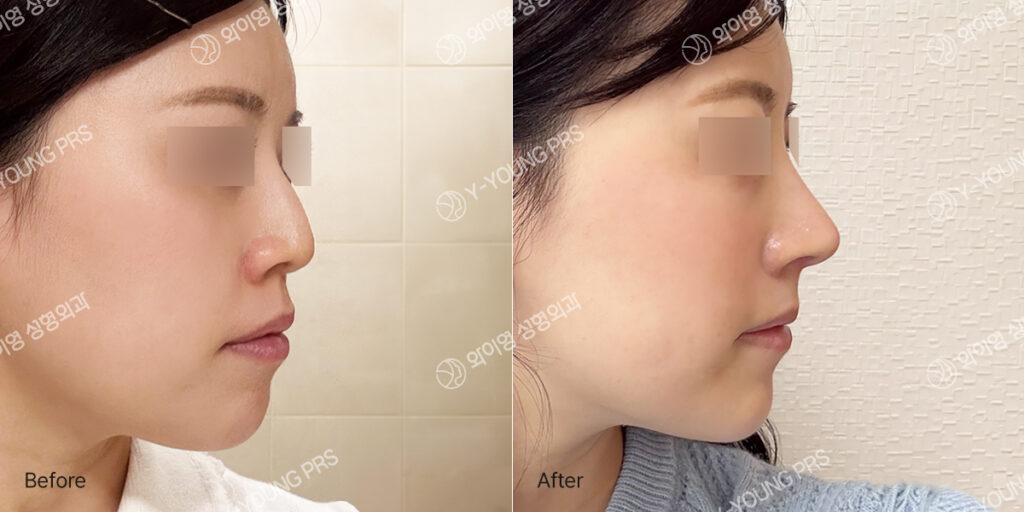
This patient had previously experienced a complication with a nasal implant and strongly wished to avoid having another synthetic implant placed in her nose.
Patients with previous implant complications often require a different evaluation from patients undergoing primary rhinoplasty. When scar tissue, weakened support, or previous implants have altered the nasal structure, the surgical plan should begin with identifying the cause of the problem rather than simply choosing a new implant.
Before surgery, she also had multiple absorbable threads that had previously been placed along the nasal bridge to create additional height.
During surgery, the remaining threads were removed, and the bridge and tip were reconstructed using an implant-free approach.
This case illustrates an important reason some patients choose no-implant rhinoplasty. The decision is not based on the idea that silicone is inappropriate for everyone. In this patient, her previous experience and strong preference to avoid another permanent synthetic implant made an implant-free approach particularly appropriate.
Even after removing the material that had previously been used to augment the bridge, it was possible to maintain substantial dorsal height and create a defined nasal profile without placing a silicone implant.
Learn more about Dr. Kim Hye-young’s approach to revision rhinoplasty in Korea.
Case 2 — No-Implant Rhinoplasty for a Naturally Low Male Nose
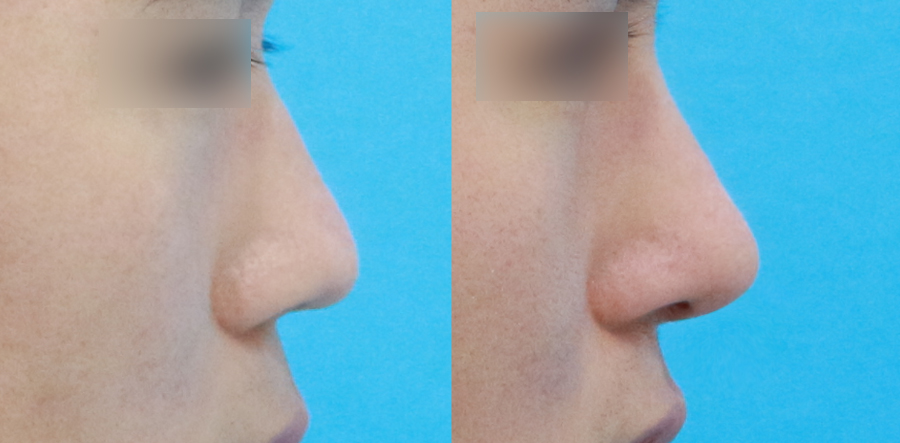
Male patients are particularly useful for illustrating another misconception about implant-free rhinoplasty.
A patient may begin with very little dorsal height but still want a clearly visible increase in bridge projection.
It is sometimes assumed that this degree of augmentation automatically requires silicone.
That is no longer always the case in my practice.
When adequate cartilage is available, I can build considerable dorsal height while maintaining an implant-free approach.
For male rhinoplasty, however, simply making the bridge higher is not the goal.
I also consider the radix, brow-tip relationship, dorsal width, tip projection, nasolabial angle, and the overall strength of the facial features.
The result should look appropriate for that individual face rather than simply reproducing a standard rhinoplasty shape.
Case 3 — No-Implant Rhinoplasty for an Already High Nose With a Hump
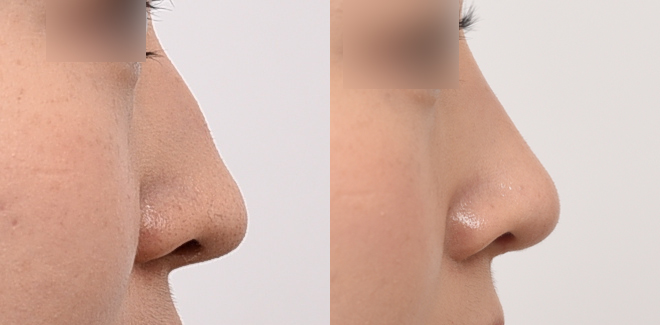
This represents a more traditional indication for implant-free rhinoplasty.
When a patient already has adequate nasal height, there may be little reason to introduce additional dorsal volume with a synthetic implant.
Instead, the existing bony and cartilaginous framework can be modified, and cartilage can be used selectively where additional support or contour adjustment is required.
In this situation, the purpose of surgery is not necessarily to make the nose higher.
It may be to change the dorsal line, refine the tip, improve the relationship between the bridge and tip, or create better balance with the rest of the face.
This illustrates an important principle:
Rhinoplasty should not begin with the choice of material. It should begin with an analysis of the existing nose.
Not Sure Whether No-Implant Rhinoplasty Is Right for You?
The choice between cartilage-based rhinoplasty and silicone depends on your nasal anatomy, previous surgery, available cartilage, and the result you want to achieve.
How Much Can a Nose Be Raised Without Silicone?
There is no single number that applies to every patient.
The amount of augmentation I can create depends on several factors, including the patient’s existing nasal anatomy, skin and soft-tissue characteristics, available cartilage, previous surgery, desired bridge height, and the amount of structural support required.
For modest changes, septal cartilage may sometimes provide sufficient material.
When significantly more volume or structural strength is required, autologous rib cartilage may become useful.
This is particularly relevant in complex primary rhinoplasty and revision rhinoplasty where the amount of available septal cartilage may be limited.
Patients interested in this aspect can also read:
When Is Autologous Rib Cartilage Necessary in Revision Rhinoplasty?
What About the Rib Cartilage Scar?
When autologous rib cartilage is required, patients understandably worry about the donor-site scar.
I generally harvest the cartilage through a small incision, but the final appearance of the scar varies depending on individual healing characteristics.
A detailed explanation and actual postoperative examples are available here:
Rib Cartilage Scar in Rhinoplasty: Is It Visible?
Silicone vs. No-Implant Rhinoplasty: How I Decide
I do not have a rule that says every low nose needs silicone or that every patient should avoid it.
That was closer to how the decision was made in the past:
Already enough height → no implant could be considered.
Need substantial augmentation → silicone was usually necessary.
My current approach is different.
Today, even a substantially low nose can sometimes be augmented without silicone.
So the decision has shifted from simply asking “How low is the nose?” to asking several more useful questions:
How much augmentation is required?
What structural support does the nose need?
What cartilage is available?
What type of dorsal contour does the patient prefer?
How does the patient feel about having a permanent synthetic implant?
These answers guide my choice.
If You Want Subtle Natural Transitions Along the Bridge
No-implant rhinoplasty may be particularly appealing.
Cartilage is living biological tissue and undergoes healing and remodeling.
As a result, the dorsal surface may not remain as uniformly smooth as a solid implant.
For some patients, that is not a disadvantage.
A slightly more organic transition between different parts of the nasal dorsum can complement a well-defined tip and create the type of three-dimensional contour they prefer.
If You Want a Particularly Smooth Dorsal Line
Silicone may sometimes be the better option.
A customized 3D silicone implant allows me to control the surface of the bridge very precisely.
And again, smooth does not mean unnatural.
A well-designed implant does not need to create an excessively high radix or a stereotypical straight implant line.
Modern customization allows the implant to follow the intended anatomy and aesthetic design much more closely.
This is why I continue to use both techniques.
What If My Main Concern Is Avoiding Future Implant Problems?
For patients who strongly wish to avoid the long-term risks specifically associated with a permanent synthetic nasal implant, no-implant rhinoplasty deserves serious consideration.
This is different from promising that the nose will never have a problem.
No surgical material and no rhinoplasty technique can guarantee that.
Autologous cartilage has its own healing behavior and potential complications.
But if a patient’s priority is specifically not having permanent silicone inside the nose, cartilage-based rhinoplasty allows us to pursue that goal — and today, this option is no longer restricted only to patients who already have a high nasal bridge.
My Approach to No-Implant Rhinoplasty
The biggest change in my thinking over the years is not that I have decided cartilage is better than silicone.
It is that I no longer consider a low nasal bridge an automatic indication for silicone.
As surgical techniques have evolved, the range of noses that I can treat without an implant has expanded.
At the same time, I continue to use customized silicone when its characteristics better match the result a patient wants.
The choice is therefore not ideological.
I do not start a consultation by deciding:
“This patient should have silicone.”
or
“This patient should never have silicone.”
I first look at the anatomy.
Then I consider how much structural change is required, what materials are available, what kind of contour the patient prefers, and what trade-offs the patient is comfortable accepting.
Only then do I choose the material.
So, Is No-Implant Rhinoplasty Better?
Not necessarily.
And silicone is not necessarily better either.
They are different tools.
For a patient who values a defined tip, biological graft material, subtle transitions along the bridge, and avoidance of a permanent synthetic implant, no-implant rhinoplasty may be an excellent choice.
For a patient who places greater importance on a particularly smooth, precisely controlled dorsal surface, customized silicone may sometimes produce the characteristics they prefer.
Most importantly, the old assumption:
“Low nose = silicone, high nose = no implant”
is no longer how I approach rhinoplasty.
Today, a patient can have a naturally low nose and still potentially achieve substantial dorsal augmentation without silicone.
The question is not simply whether a nose can be operated on without an implant.
The better question is:
Which approach will create the most appropriate structure and contour for this particular nose?
Dr. Kim Hye-young
Board-Certified Plastic Surgeon
Y-Young Plastic Surgery, Seoul
Frequently Asked Questions
Can a very low nose be raised without a silicone implant?
Yes, in selected patients. Modern cartilage-based techniques can create substantial dorsal augmentation even in some patients with naturally low nasal bridges. Whether this is appropriate depends on the available cartilage, skin and soft-tissue characteristics, desired height, and structural requirements of the nose.
Does no-implant rhinoplasty look more natural than silicone rhinoplasty?
Not necessarily. Both approaches can create natural-looking results. Cartilage may produce subtle transitions along the nasal bridge as it heals, while customized silicone can provide a smoother and more controlled dorsal contour. The better choice depends on the patient’s anatomy and aesthetic preference.
Can cartilage used for the nasal bridge be absorbed?
Some degree of remodeling or absorption can occur because cartilage is biological tissue. The extent varies depending on the type of graft, surgical technique, and individual healing. This is one of the factors that should be discussed when comparing cartilage-based augmentation with a solid implant.
Is silicone safer than rib cartilage?
Neither material should be described as universally safer. Silicone has potential implant-specific complications, while autologous cartilage has its own risks and healing characteristics. Material selection should be individualized according to the patient’s anatomy, surgical goals, and priorities.
Learn More About No-Implant Rhinoplasty in Korea →

