Is Zygoma Reduction Surgery Simply About “Reducing the Cheekbones”?
Many people think zygoma reduction surgery simply means pushing prominent cheekbones inward.
However, the cheekbone structure that influences overall facial impression is not just a single area. It can generally be divided into:
anterior cheek
45-degree cheekbone
zygomatic arch
Each part plays a different role in facial balance and contour.
Because of this, simply “reducing more bone” does not necessarily create a more attractive facial line.
Should the Anterior Cheekbone Always Be Reduced?
Surprisingly, maintaining some anterior cheek volume often creates a more youthful and lively appearance.
Especially in Asian faces, preserving appropriate anterior cheek projection is important because it helps:
prevent the face from looking too flat,
avoid a sunken midface appearance,
maintain natural facial dimension and contour.
On the other hand, excessive reduction of anterior cheek volume may make the face appear tired or aged.
For this reason, during zygoma surgery, I usually focus on appropriately reducing the 45-degree cheekbone and zygomatic arch while preserving — or sometimes even enhancing — the volume of the anterior cheek.
The 45-Degree Cheekbone and Zygomatic Arch Are Key to a Smaller-Looking Face
In many patients, the areas that make the face appear wider from multiple angles are actually the 45-degree cheekbone and the zygomatic arch.
Particularly in patients whose facial outline appears broad even at rest, prominence of the zygomatic arch often plays a major role.
Therefore, in zygoma surgery, proper setback of the 45-degree cheekbone and natural inward movement of the zygomatic arch are extremely important.
However, even in this process, “more reduction” is not always the correct answer.
Excessive setback can lead to:
unnatural facial contours,
soft tissue sagging,
loss of facial dimension,
an artificial appearance.
In Zygoma Surgery, “Reposition” Matters More Than Bone Removal
In jaw contour surgery, the actual amount of bone removal can sometimes be an important factor.
However, in zygoma surgery, what matters more is not how much bone is removed, but how accurately and stably the zygoma is repositioned.
Especially in patients whose cheekbone size is not excessively large, significant improvement can often be achieved through proper repositioning alone, even without major bone resection.
The zygoma is not simply a bone to shave down. After osteotomy, it must be repositioned and stabilized in a new location.
For this reason, both anterior fixation and posterior fixation are extremely important in zygoma surgery, and the direction of setback and rotational movement of the 45-degree cheekbone must be carefully planned.
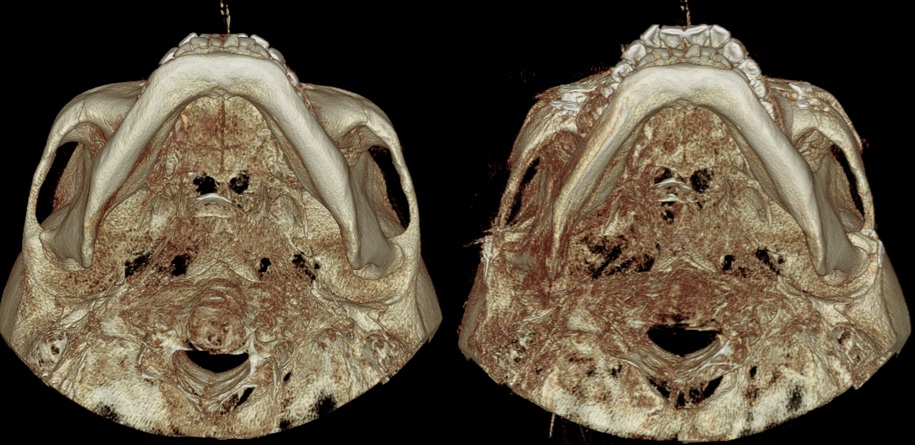
3D CT comparison before and after zygoma reduction surgery demonstrating smoother arch contour and effective cheekbone repositioning.
Important Factors in Preventing Soft Tissue Sagging
One of the biggest concerns after zygoma surgery is soft tissue sagging.
To minimize this risk, basic surgical principles are extremely important, including:
minimal dissection,
superior fixation,
stable bony fixation.
In selected cases, additional minor procedures may also be performed to help prevent soft tissue sagging.
Ultimately, zygoma surgery is not simply about “making the cheekbones smaller.” It is closer to a highly detailed facial balancing surgery that requires consideration of:
bone structure,
soft tissue,
facial dimension,
and shadow lines.
More Reduction Is Not Always Better
A naturally refined facial contour is not created by removing the greatest amount of bone.
Rather, it comes from moving each structure into an appropriate position according to overall facial proportion and creating smooth transitions between facial contours.
Especially in zygoma surgery, not only the frontal view, but also the 45-degree view, side profile, and facial movement during smiling must all be considered in order to achieve natural and long-lasting results.
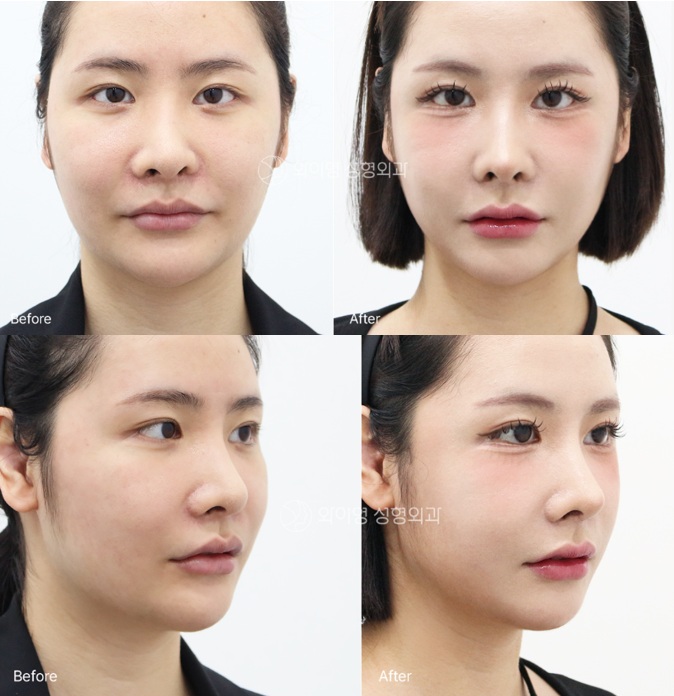
Postoperative 1-month results after zygoma reduction surgery demonstrating improved facial balance and softer cheekbone contour. For overall facial balance and harmony, rhinoplasty was also performed together in this case.