Autologous Rib cartilage in revision rhinoplasty is not necessary for every patient. One of the most common questions I hear from patients considering revision surgery is, “Do I really need rib cartilage?”
The answer is no. Not every revision rhinoplasty requires rib cartilage.
The more important questions are how much usable cartilage remains after previous surgery, how much structural support the nose needs, and what needs to be reconstructed.
In my practice, I use autologous rib cartilage relatively often for complex revision rhinoplasty. This is particularly true after multiple previous surgeries, in contracted or severely shortened noses, and when the original nasal framework has been significantly weakened.
However, I do not choose rib cartilage simply because a surgery is a revision.
The graft material should be selected according to the anatomy and structural requirements of each nose.
Learn more about our approach to revision rhinoplasty in Korea→
Why Is Rib Cartilage Often Needed in Revision Rhinoplasty?
In primary rhinoplasty, septal cartilage is often an excellent source of cartilage for structural grafting.
Revision rhinoplasty is different.
Part of the septal cartilage may already have been harvested during previous surgery. In some patients, it has been weakened, damaged, or altered by multiple operations or previous trauma.
Before revision surgery, I therefore want to know:
How much usable septal cartilage is actually left?
If there is enough healthy septal cartilage to perform the reconstruction I am planning, autologous rib cartilage may not be necessary.
If there is not enough, I need another source that can provide sufficient cartilage with the strength required to rebuild a stable nasal framework.
This is where autologous rib cartilage becomes particularly useful.
1. After Multiple Previous Rhinoplasty Surgeries
The more operations a nose has undergone, the more likely it is that the original septal cartilage has already been harvested or altered.
Scar tissue also changes the surgical environment.
In these cases, revision surgery may no longer be simply about reshaping the nose. The supporting framework itself may need to be reconstructed.
Autologous rib cartilage provides enough material to create multiple structural grafts when necessary, which is why I use it frequently in patients who have undergone several previous rhinoplasty procedures.
2. Contracted or Severely Shortened Nose
A contracted or severely shortened nose is one of the situations in which I most commonly use autologous rib cartilage.
The problem is often not limited to a short-looking nasal tip.
After previous surgery and scar contracture, the skin and soft-tissue envelope can become tight. Lengthening the nose means creating a new framework that must maintain its position against this soft-tissue tension.
In these cases, a strong structural framework becomes especially important.
The tighter the soft-tissue envelope, the more important stable structural support becomes.
This is one of the reasons I frequently prefer rib cartilage when reconstructing a contracted or significantly shortened nose.
3. When the Nasal Tip Has Lost Structural Support
A weak or poorly supported nasal tip does not automatically mean that rib cartilage is necessary.
Some patients naturally have a large and strong septum. This is relatively common in Western patients, but I also see Asian patients with substantial septal cartilage.
If enough healthy septal cartilage remains, it may provide all the structural support I need.
For this reason, I try to evaluate the septum before surgery rather than assuming that every revision patient will require rib cartilage.
At Y-Young, preoperative CT imaging is one of the tools I use to assess the septum and overall nasal structure. I combine this information with physical examination and the patient’s previous surgical history when planning the revision.
The question is not whether this is a “revision nose.”
The question is whether the remaining septum can provide enough cartilage for the reconstruction I am planning.
4. Severe Contracture or Major Nasal Reconstruction
Some revision cases require much more than a small cosmetic correction.
Previous implant complications, infection, severe scar contracture, skin damage, or tissue loss can leave both the soft tissue and structural framework compromised.
In these situations, the operation becomes reconstructive.
I may need cartilage not only to support the nasal tip but also to rebuild several components of the nose.
Having a sufficient amount of strong graft material is particularly important in these cases, which is another reason I often choose autologous rib cartilage for complex nasal reconstruction.
5. Severely Crooked Nose After Previous Surgery or Trauma
A crooked nose does not automatically require rib cartilage.
If the external nose is deviated but the internal septum remains relatively intact, it may be possible to perform the correction using the patient’s remaining septal cartilage.
But many severe crooked-nose revision patients have a more complicated history.
Some have experienced significant nasal trauma. Others have undergone previous operations that removed, weakened, or distorted the septal cartilage.
When both the external nose and its internal supporting structures have been compromised, a larger amount of strong cartilage may be necessary to rebuild a straighter and more stable framework.
This is why I do not decide whether rib cartilage is necessary based simply on how crooked the nose appears from the outside.
The condition of the internal septum can be more important than the visible degree of deviation.
When Can I Perform Revision Rhinoplasty Without Rib Cartilage?
Revision rhinoplasty does not automatically mean rib cartilage.
If the previous operation did not significantly harvest the septum, there may still be enough septal cartilage available.
This is especially true in patients who naturally have a large septum.
If the remaining septal cartilage provides enough quantity and strength for the surgical plan, I prefer to use what is already available rather than harvest additional cartilage unnecessarily.
This is why evaluating the existing nasal structure before revision surgery is so important.
Why I Do Not Usually Rely on Ear Cartilage for Major Structural Support
Ear cartilage certainly has a role in rhinoplasty, but I do not usually rely on it as the main structural material for complex revision cases.
It is softer and has different mechanical characteristics from septal or rib cartilage. I am also more cautious about relying on it when long-term structural strength is particularly important.
For selected purposes, ear cartilage can still be very useful.
But when I need substantial cartilage and strong structural support, my preference is generally to use the patient’s septal cartilage if there is enough, or rib cartilage when there is not.
Autologous Rib Cartilage vs. Donor Rib Cartilage
I use both autologous and donor rib cartilage depending on the patient and the type of reconstruction required.
Autologous rib cartilage provides a substantial amount of the patient’s own cartilage and is my preferred material in many complex revision cases where I need to create a strong structural framework.
However, it is not necessarily the right choice for every patient.
As patients get older, rib cartilage can become increasingly calcified. If the patient’s own rib is significantly calcified and less suitable for precise carving and reconstruction, donor rib cartilage can be a useful alternative.
I may also consider donor rib cartilage for a patient who strongly wishes to avoid a chest incision and donor-site scar.
Donor rib cartilage undergoes tissue-bank processing before implantation, and processing methods vary among graft products. For this reason, I consider the characteristics of the specific graft rather than treating all donor rib cartilage as identical.
Ultimately, I do not think of the choice as simply “autologous is better” or “donor cartilage is better.”
I consider the patient’s age, the condition and amount of remaining septal cartilage, the quality of the patient’s rib cartilage, the amount and strength of graft material required, and the type of reconstruction being performed.
What About the Rib Cartilage Scar?
The chest scar is understandably one of the main concerns patients have when I recommend autologous rib cartilage.
Because I perform rib cartilage harvesting frequently, I generally use an incision of less than 2 cm in my practice, although the exact incision may vary according to the patient’s anatomy and the amount of cartilage required.
The cartilage harvest itself usually takes me approximately 20 minutes.
However, scar healing varies from person to person. Skin characteristics and an individual’s tendency toward hypertrophic or keloid scarring can also affect the final appearance.
If the chest scar is one of your main concerns, you can read my detailed guide:
Rib Cartilage Scar in Rhinoplasty: Is It Visible?
Three Different Reasons I May Choose Autologous Rib Cartilage
The following cases demonstrate an important point:
I do not use autologous rib cartilage for the same reason in every patient.
Sometimes I need it because the nose has lost its structural framework. Sometimes the soft tissue has been severely damaged. In other patients, scar contracture creates a tight nose that requires stronger support.
Case 1 — Reconstruction After Filler Necrosis
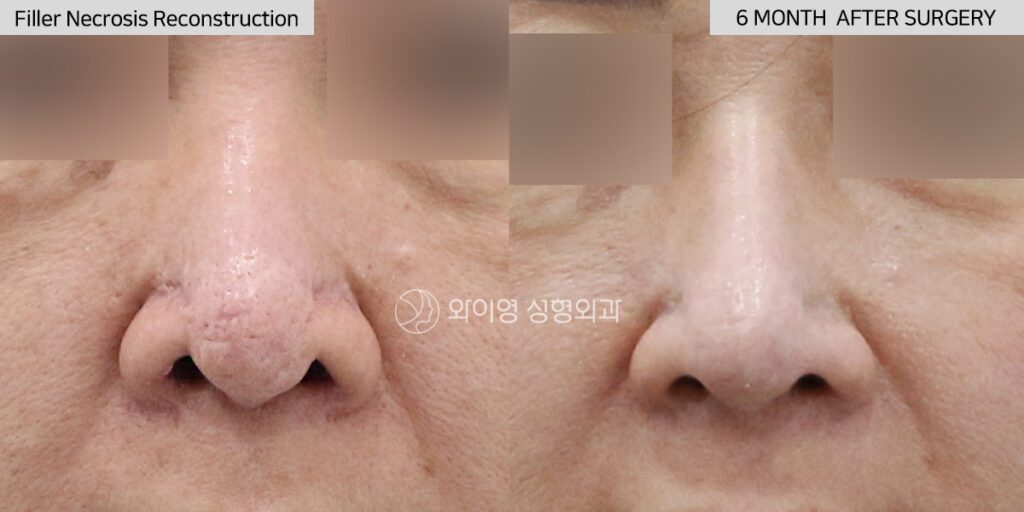
This patient developed nasal tip skin necrosis after a previous filler injection.
By the time she came to Y-Young, the acute injury had healed, but it had left significant scar contracture, soft-tissue deficiency, and tight, damaged skin.
This was not simply a case of reshaping the nasal tip.
The nose needed reconstruction.
I used autologous rib cartilage to reconstruct both the nasal bridge and tip, providing the structural foundation of the reconstructed nose.
Because there was also a skin and soft-tissue deficiency at the nasal tip, a composite ear graft was used to reconstruct the damaged area.
View the full case: Filler Necrosis Reconstruction with Rib Cartilage in Korea
Case 2 — Reconstruction After Silicone Implant Extrusion
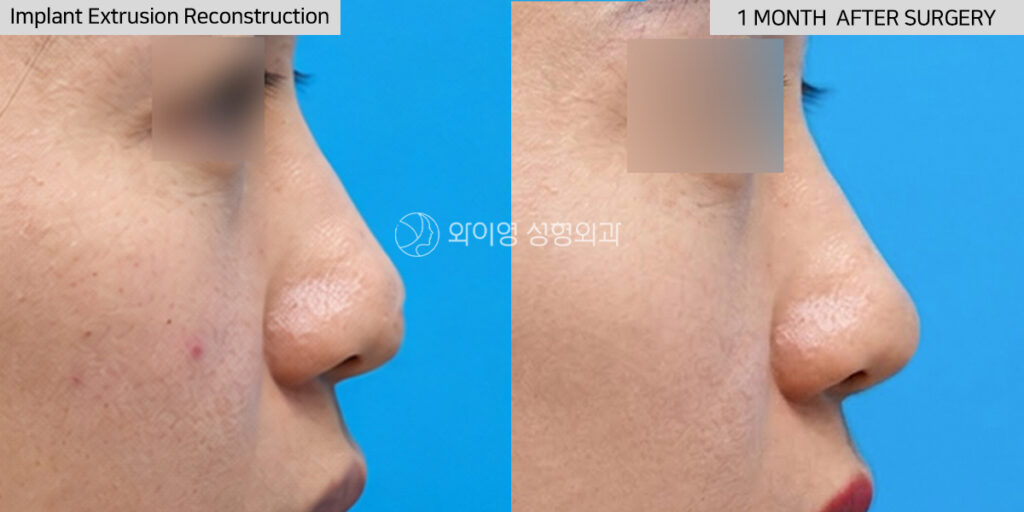
This patient had experienced extrusion of a previous silicone implant through the nasal tip.
The resulting damage left extremely thin, contracted skin and severely compromised nasal support.
Before definitive reconstruction, improving the condition of the soft tissue was an important part of the treatment plan.
I then used autologous rib cartilage to reconstruct the nasal bridge and tip without placing another permanent silicone implant.
Because the nasal tip skin had become particularly thin, rib perichondrium was also used as an additional protective layer over the reconstructed framework.
View the full case: Silicone Implant Extrusion Reconstruction in Korea
Case 3 — Contracted Nose After Previous Rhinoplasty
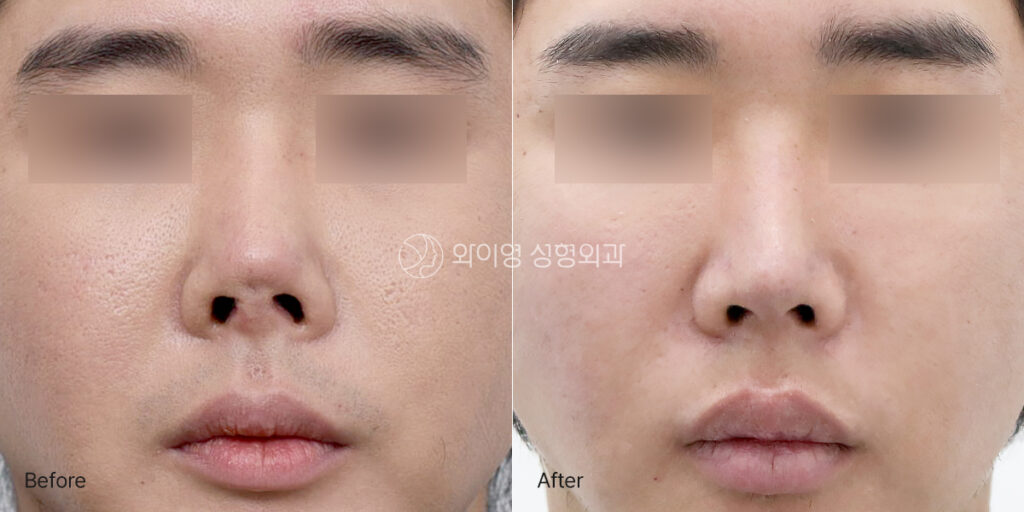
Contracted nose revision presents a different problem.
After previous rhinoplasty, scar contracture can shorten the nose while making the skin and soft-tissue envelope tight. At the same time, the existing structural support may already have been weakened by the previous operation.
In this situation, simply changing the shape of the tip is not enough.
The goal is to release the contracted tissues and rebuild a framework strong enough to maintain the reconstructed nasal length and tip position.
In this patient, I used autologous rib cartilage to provide the structural support required for reconstruction.
View the full case: Contracted Nose Revision in Korea
These three cases look very different, but they demonstrate the same principle:
Graft selection should follow the reconstructive problem—not a predetermined preference for a particular material.
Autologous rib cartilage is only one part of complex revision surgery. The more important decision is determining why the previous rhinoplasty failed and what structural support remains. For patients researching revision rhinoplasty in Korea, Dr. Kim Hye-young evaluates the previous surgical history, scar tissue, skin condition, remaining cartilage, nasal support, and functional problems before deciding whether rib cartilage or another reconstructive approach is appropriate.
How I Decide Before Revision Rhinoplasty
One of the most important parts of revision rhinoplasty is understanding what structures and graft materials are likely to be available before entering the operating room.
I review the patient’s previous surgical history, examine the nose, and assess the existing nasal structure with preoperative imaging when appropriate.
I want to understand:
- How much usable septal cartilage is likely to remain?
- How strong does the reconstructed framework need to be?
- How much graft material will be required?
- Is the skin and soft-tissue envelope tight?
- Has trauma or previous surgery damaged the internal supporting structures?
Only after answering these questions can I decide whether the remaining septal cartilage is sufficient or whether rib cartilage is the better option.
Final Thoughts
Autologous rib cartilage is not necessary for every revision rhinoplasty.
But in complex revision surgery—particularly after multiple previous operations, severe contracture, a short and tight nose, major structural damage, or significant septal deficiency—it can provide something that smaller cartilage sources cannot:
a sufficient amount of strong cartilage to rebuild a stable nasal framework.
At the same time, I do not harvest rib cartilage simply because a patient is undergoing revision surgery.
If the septum is intact, sufficiently large, and strong enough for the reconstruction, I use what is already available.
For me, the question is not simply:
“Should I use rib cartilage?”
The more important question is:
“What does this nose need to remain structurally stable after revision surgery?”
That is what should determine the choice of cartilage.
Frequently Asked Questions
Does every revision rhinoplasty require rib cartilage?
No. If enough healthy septal cartilage remains from previous surgery and it provides sufficient strength for the planned reconstruction, rib cartilage may not be necessary. The decision depends on the remaining nasal structure and how much support is required.
Why is autologous rib cartilage often used for contracted nose revision?
A contracted nose often has a tight skin and soft-tissue envelope combined with weakened or shortened structural support. Autologous rib cartilage can provide enough strong cartilage to rebuild a framework capable of maintaining the reconstructed nasal length and tip position.
Is donor rib cartilage an alternative to autologous rib cartilage?
Yes. Donor rib cartilage can be considered in selected patients, including those with significantly calcified rib cartilage or those who strongly wish to avoid a chest incision. The choice depends on the patient’s anatomy, the type of reconstruction, and the amount and strength of cartilage required.

