Thick Skin Rhinoplasty: Why Tip Definition Takes Longer
Patients with thick nasal skin are among the more challenging cases in rhinoplasty.
One of the most common concerns I hear from these patients after surgery is:
“Why does my nose tip still look round or swollen?”
This is especially common in patients who had a bulbous nose before surgery.
The reason is that rhinoplasty changes the structure underneath the skin, but what we ultimately see from the outside is the way the skin and soft tissue settle over that new structure.
And when that covering is thick, the relationship between the two becomes particularly important.
A Simple Way to Understand Thick Skin
I sometimes explain this to patients using a simple analogy.
Think of the difference between a thin-skinned tangerine and a Hallabong, a Korean citrus fruit with a much thicker, heavier peel.
With a thin covering, even a relatively small change in the structure underneath can be reflected clearly on the surface.
With a thick, heavy covering, however, changing the structure underneath does not necessarily produce the same degree of visible change on the outside.
The nasal tip can behave in a similar way.
In patients with thin skin, relatively subtle changes to the cartilage framework may become clearly visible.
With thick skin and abundant soft tissue, even a well-defined cartilage framework can be partially masked by the tissue covering it.
This is one of the reasons thick skin rhinoplasty requires careful planning, realistic expectations, and patience during recovery.
What Actually Makes a Nose Look Bulbous?
A bulbous nasal tip does not have a single cause.
When I examine a patient with a wide or rounded tip, I try to determine what is actually creating that appearance.
Possible factors include:
- broad or widely positioned lower lateral cartilages
- weak or poorly defined tip support
- thick nasal skin
- abundant soft tissue over the tip
- the overall width and shape of the nasal framework
In many patients, several of these factors exist at the same time.
This distinction matters because thick skin and a bulbous nose are not exactly the same thing.
A patient can have broad tip cartilage with relatively thin skin.
Another patient may have cartilage that is not particularly wide, but thick skin and soft tissue make the tip appear much larger.
And many patients have both.
The operation therefore needs to be designed around the actual anatomy rather than simply treating every bulbous nose in the same way.
Thick Skin Changes What Rhinoplasty Can — and Cannot — Do
If cartilage is the main reason a nasal tip looks wide, reshaping or repositioning that cartilage can produce a relatively direct change in tip contour.
But when thick skin and soft tissue contribute significantly to the apparent size of the tip, simply making the cartilage underneath smaller does not guarantee that the outside of the nose will become equally narrow.
This is an important limitation to understand.
We are reshaping the framework beneath the skin. We cannot simply replace the skin that covers it.
For that reason, the same degree of cartilage refinement can look very different in two patients with different skin thicknesses.
This does not mean that thick skin cannot improve.
It means that the surgical plan—and the expected result—should take the soft-tissue envelope into account.
Why Not Just Remove More Cartilage?
Patients sometimes ask a very reasonable question:
“If my tip is large, why not just remove more cartilage?”
Unfortunately, more reduction does not always mean more definition.
The nasal tip needs a stable structural framework to maintain its shape over time.
Removing too much cartilage can weaken tip support rather than create a better result.
This is particularly important in thick-skinned patients.
If the soft-tissue envelope is relatively heavy, the framework underneath needs enough strength to support it.
For this reason, I often think less about:
“How much cartilage can I remove?”
and more about:
“How can I create a stable, well-defined framework that will remain visible beneath this skin?”
Depending on the individual anatomy, surgery may involve reshaping existing cartilage, repositioning the tip structures, improving support, or using cartilage grafts when additional structural strength is needed.
Sometimes the better strategy is not more reduction, but better structure.
What About Removing Soft Tissue?
This is another area where caution is important.
When there is abundant soft tissue beneath the skin, carefully reducing selected tissue may sometimes be considered as part of the surgical plan.
However, this does not mean that all of the tissue underneath thick skin should simply be removed.
Aggressive soft-tissue removal can potentially affect circulation, create irregularities, or lead to other problems.
The goal is therefore not to make the skin envelope as thin as possible.
The goal is to balance the soft tissue with the newly created cartilage framework while preserving healthy tissue.
In thick skin rhinoplasty, aggressive surgery is not necessarily precise surgery.
Why Can the Tip Still Look Big at One Month?
This becomes especially important during recovery.
One month after rhinoplasty can be a frustrating stage for patients with thick skin.
The bridge may already look relatively slim, while the tip still appears:
- round
- wide
- firm
- swollen
- less defined than expected
Patients sometimes look at the bridge and then at the tip and wonder why the two seem to be recovering at different speeds.
This is very common.
The nasal tip is usually one of the last areas of the nose to lose swelling, and thicker skin can retain postoperative edema for longer.
As a result, the structural changes created during surgery may not yet be fully visible.
For this reason, I do not judge the final tip shape at one month, particularly in patients who had thick skin or a bulbous tip before surgery.
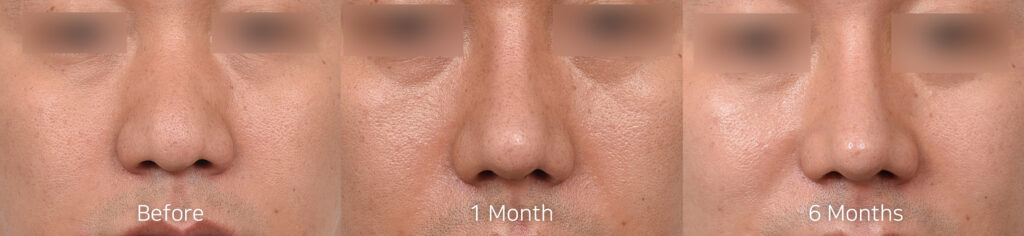
Real Case: Thick Skin and a Bulbous Tip
This patient had a broad, rounded nasal tip with relatively thick skin and soft tissue.
At one month after surgery, the tip was already narrower than before surgery, but it still appeared relatively full and rounded.
This is an important stage to understand.
If we looked only at the one-month photograph, it would be easy to wonder whether the tip would remain this way.
By six months, however, the contour had become noticeably more defined as postoperative swelling continued to resolve and the soft tissue gradually settled over the underlying framework.
The nose did not suddenly undergo another structural change between one and six months.
What changed was how clearly the underlying structure could be seen through the healing skin and soft tissue.
This is why early postoperative photographs should be interpreted carefully, especially in patients with thicker skin.
The 1–2 Month “Plateau”
Another pattern I frequently see is a period when patients feel that their nose has stopped changing.
During the first few weeks, swelling often decreases relatively quickly.
Then, around one to two months after surgery, the change may seem to slow down.
Patients who look at their nose every day may feel that the tip has remained exactly the same for several weeks.
I sometimes describe this as a swelling plateau.
It does not mean that healing has stopped.
Recovery is simply not always linear.
In some thick-skinned patients, the tip may appear relatively unchanged for several weeks and then look noticeably more defined around the second or third month.
The cartilage did not suddenly become narrower.
Rather, enough residual swelling has resolved for the structure underneath to become easier to see.
Why Does Thick Skin Take Longer to Show Definition?
The structural work of rhinoplasty is performed during surgery.
But the visible result depends on what happens afterward as the skin and soft tissue heal around that structure.
With a thin soft-tissue envelope, the underlying framework may become visible relatively quickly.
With thicker tissue, swelling can remain longer and subtle structural details can take more time to become apparent.
This is why comparing a thick-skinned patient’s one-month result with another patient’s six-month result can be very misleading.
They are not only at different stages of healing.
They may also have completely different skin characteristics.
What Changes Around 2–3 Months?
For many patients, the second and third months are when the nose begins to feel less like an “operated nose.”
The tip gradually becomes softer.
The transition between the bridge and tip can appear more natural.
Small differences in swelling between the two sides may become less noticeable.
And in patients with thick skin, the definition created underneath may finally start becoming easier to see.
This does not mean that the nose is completely healed at three months.
Further refinement can continue for many months, particularly at the tip.
But it is often around this stage that patients begin to understand the direction of their final result more clearly.
Can Thick Skin Still Have Good Tip Definition?
Yes.
Thick skin does not mean that rhinoplasty cannot create a meaningful improvement.
But the definition should be appropriate for the patient’s anatomy.
A very thin-skinned patient and a very thick-skinned patient should not necessarily be promised the same degree of sharp tip definition, even if similar structural changes can be made underneath.
Trying to force an extremely narrow or pointed tip beneath a thick soft-tissue envelope may not produce a natural result.
And excessive reduction in pursuit of that goal can compromise structural support.
For me, successful thick skin rhinoplasty is not about creating the smallest possible nose.
It is about creating a better-defined, better-supported nasal tip that remains in proportion with the rest of the nose and face.
Thick Skin Can Also Have an Advantage
There is another side to this discussion.
Thin skin shows definition easily—but it can also reveal very small irregularities in the cartilage underneath.
A minor asymmetry or edge that might never be visible through thicker skin can sometimes be noticeable in a very thin-skinned patient.
Thicker skin can camouflage some of these small structural irregularities.
So neither thin nor thick skin is simply “good” or “bad” for rhinoplasty.
Each creates a different set of surgical considerations.
The important question is:
What type of surgical design works best for this particular nose?
When Can the Final Result Be Judged?
There is no single date when every rhinoplasty suddenly becomes final.
Healing depends on the extent of surgery, skin thickness, soft-tissue characteristics, whether the operation was primary or revision surgery, and individual healing patterns.
In thick-skinned patients, tip refinement often takes longer to become visible.
Meaningful changes can continue well beyond the first few months.
For this reason, I prefer to evaluate the result as a progression rather than focusing too heavily on a single early postoperative photograph.
The important question during the early months is usually not:
“Is this my final nose?”
but rather:
“Is the nose continuing to heal in the expected direction?”
My Approach to Thick Skin Rhinoplasty
When planning rhinoplasty for a patient with thick skin, I think about three things together:
the cartilage framework, the soft-tissue envelope, and time.
The framework needs enough definition and support.
The soft tissue needs to be treated carefully rather than aggressively.
And both the surgeon and patient need to understand that the result may reveal itself more gradually.
This is especially important in bulbous tip surgery.
A technically narrower cartilage framework does not automatically translate into an extremely narrow-looking tip.
The final appearance is the result of how the structure and the tissue covering it work together.
That relationship is different in every patient.
Final Thoughts
Thick skin rhinoplasty is challenging because the surgeon is not working with cartilage alone.
We are creating a new framework underneath a soft-tissue envelope that has its own thickness, weight, and healing behavior.
Understanding that relationship helps explain why some noses show definition quickly while others require considerably more time.
It also explains why simply removing more cartilage is not always the answer.
The goal should not be to make every nasal tip as narrow as possible.
The goal is to create the best definition that the patient’s anatomy can realistically support while maintaining a stable and natural-looking nasal structure.
The structural work is completed in the operating room.
The final definition takes time to reveal itself.
Frequently Asked Questions
Is thick skin bad for rhinoplasty?
Not necessarily. Thick skin can make subtle tip definition less visible and postoperative swelling may take longer to resolve, but meaningful improvement is still possible. Surgical planning needs to account for both the underlying cartilage and the thickness of the skin and soft tissue.
Why does my nose tip still look bulbous one month after rhinoplasty?
The nasal tip often retains swelling longer than the bridge. This can be more noticeable in patients with thick skin or a bulbous tip before surgery. A round or relatively wide tip at one month does not necessarily represent the final result.
Can a surgeon make thick nasal skin thinner?
Rhinoplasty primarily reshapes the underlying nasal framework. In selected cases, limited soft-tissue reduction may be considered, but aggressive thinning can create risks. The goal is not simply to make the skin as thin as possible.
How long does swelling last after thick skin rhinoplasty?
Swelling gradually improves over several months, but tip swelling can persist longer in patients with thick skin. Noticeable refinement may continue beyond three to six months, and final healing can take considerably longer depending on the individual patient and the extent of surgery.
Relative Articles

