A crooked nose after revision rhinoplasty does not always mean that the revision surgery has failed.
Revision rhinoplasty is often performed to correct problems that remained after a previous nose surgery, including a nose that still appears crooked. Naturally, most patients expect their nose to become completely straight after a revision procedure.
So it can be frustrating—and even frightening—to notice that your nose still looks slightly crooked after surgery.
Does this mean the revision rhinoplasty failed?
Not necessarily.
In many cases, a nose may appear crooked during the healing process even when the underlying structure has been successfully corrected. Understanding why this happens can help patients avoid unnecessary anxiety and know when further evaluation is truly needed.
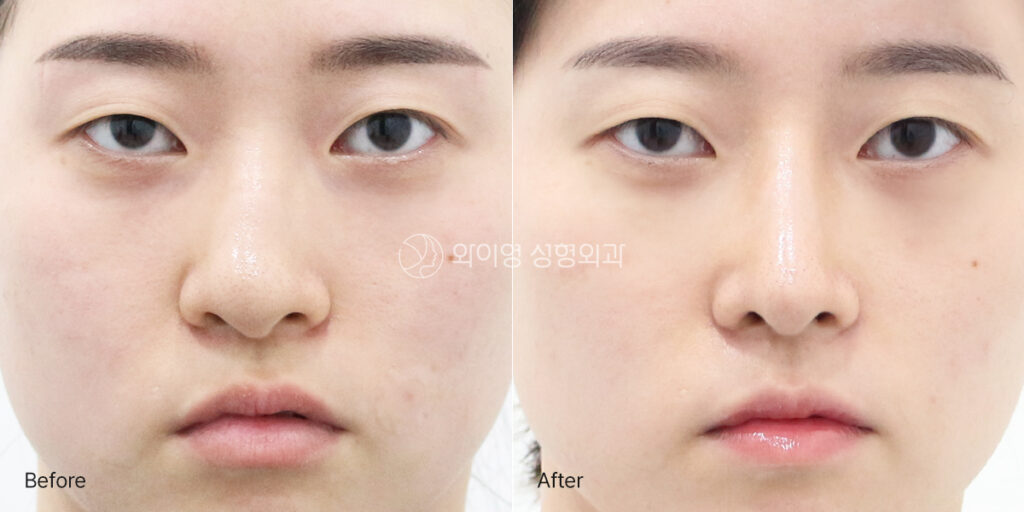
A Nose Can Look Crooked Even When the Surgery Was Successful
One of the biggest misconceptions about revision rhinoplasty is that every visible asymmetry means the operation was unsuccessful.
The appearance of the nose depends on much more than the bones and cartilage alone. Swelling, scar tissue, skin thickness, and even the natural asymmetry of the face all influence how straight the nose appears.
Especially after revision surgery, healing is more complex than after a primary rhinoplasty. Previous surgery changes the soft tissues, blood supply, and scar formation, making the recovery process longer and less predictable.
For this reason, judging the final result too early can often be misleading.
Common Reasons Your Nose Still Looks Crooked After Revision Rhinoplasty
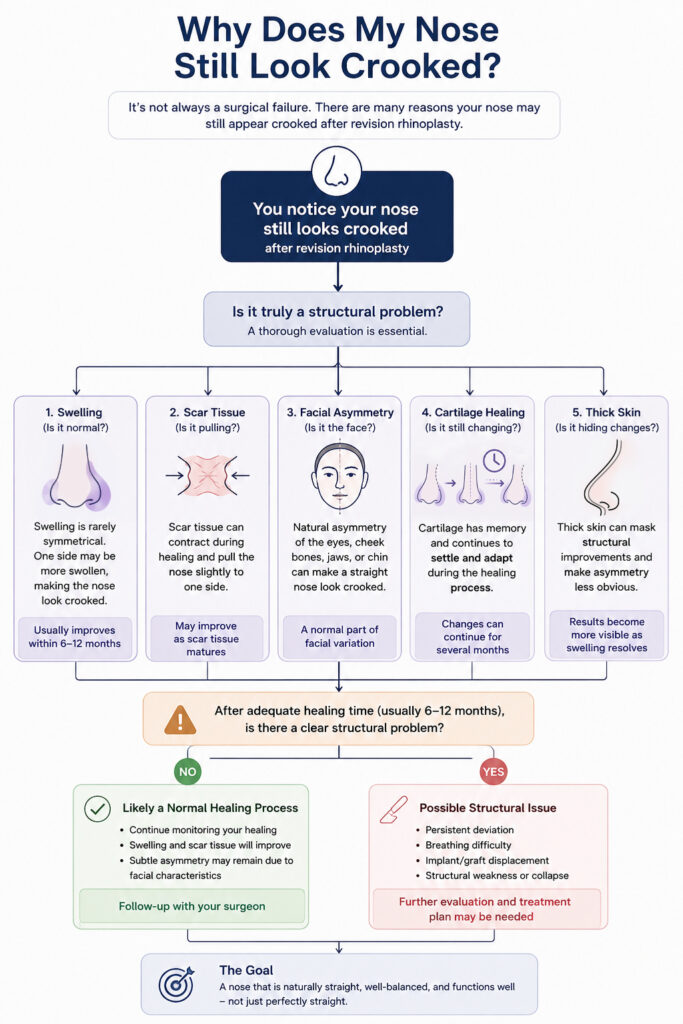
1. Swelling Is Almost Never Even
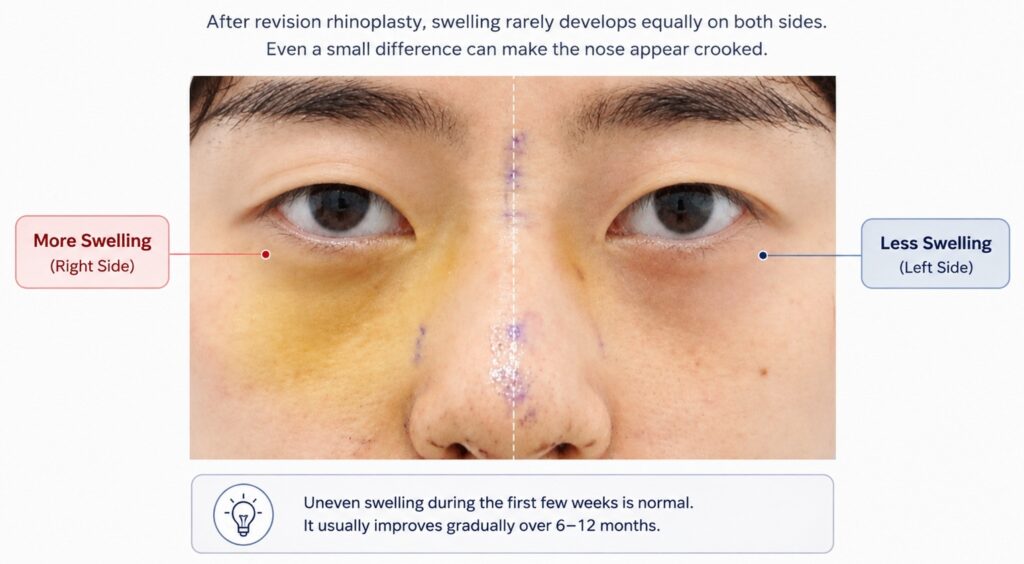
After surgery, swelling rarely develops equally on both sides of the nose.
Even a small difference in swelling can make the nose appear slightly tilted or off-center, especially when viewed from the front.
Revision rhinoplasty usually causes more swelling than a first-time procedure because the tissues have already been operated on before.
In many patients, swelling continues to improve for 6 to 12 months, and subtle refinement may continue even beyond that.
One week after revision rhinoplasty, swelling is often asymmetrical. In this case, the patient’s right side shows more swelling, making the nose appear slightly uneven during the normal healing process.
2. Scar Tissue Can Affect the Shape
Scar tissue is one of the most common reasons patients notice temporary asymmetry after revision surgery.
As the tissues heal, scar tissue contracts and matures. During this process, one side of the nose may feel firmer or appear slightly different from the other.
This does not always indicate a structural problem. In many cases, the appearance gradually improves as the scar softens over time.
3. Facial Asymmetry Can Make the Nose Look Crooked
Very few people have perfectly symmetrical faces.
The eyes, eyebrows, cheeks, upper jaw, and chin naturally differ from one side to the other. Even when the nose itself is structurally straight, these surrounding facial features may create the illusion that the nose is still crooked.
This is why experienced rhinoplasty surgeons evaluate the entire face rather than focusing only on the nose.
4. Cartilage Healing Can Continue for Months
Cartilage is a living tissue that changes as it heals.
During revision rhinoplasty, surgeons often reshape or reinforce the nasal framework using septal cartilage, ear cartilage, or rib cartilage. As healing progresses, the cartilage adapts to surrounding tissues.
These normal healing changes are carefully anticipated during surgery, but they also explain why the nose continues to evolve over several months.
5. Thick Skin May Hide Structural Improvements
Patients with thicker nasal skin often notice that visible changes take longer to appear.
Even when the internal framework has been successfully corrected, thick soft tissue can temporarily mask the new shape.
As swelling gradually resolves and the skin contracts, the final contour becomes more defined.
When Should You Be Concerned?
Although mild asymmetry is common during healing, certain signs deserve further evaluation by your surgeon.
You should consider a professional assessment if you notice:
- The nose becoming progressively more crooked over time
- Significant difficulty breathing through one side
- Visible movement of an implant or graft
- Persistent pain, redness, or signs of infection
- Structural collapse of the nose
These situations are different from the normal healing process and may require additional treatment.
How Surgeons Evaluate Persistent Crookedness
When patients are concerned about a crooked nose after revision rhinoplasty, experienced surgeons look beyond photographs alone.
A comprehensive evaluation includes:
- Frontal and side-view analysis
- Assessment of facial symmetry
- Examination of nasal support structures
- Airway evaluation
- Scar tissue assessment
- Previous surgical history
Only after identifying the true cause can an appropriate treatment plan be recommended.
Is Another Revision Always Necessary?
Fortunately, the answer is often no.
Many patients who worry during the first several months after surgery eventually see continued improvement as swelling subsides and the tissues mature.
Revision rhinoplasty should generally be considered only after healing is complete, unless there is a clear structural complication that requires earlier intervention.
Patience is often an important part of achieving the best long-term result.
Final Thoughts
A nose that still appears slightly crooked after revision rhinoplasty does not automatically mean the surgery was unsuccessful.
Healing after revision surgery is influenced by many factors, including swelling, scar tissue, cartilage remodeling, skin thickness, and natural facial asymmetry.
Rather than focusing on small changes during the early recovery period, it is important to allow adequate healing time and have regular follow-up evaluations with your surgeon.
A careful assessment by an experienced revision rhinoplasty specialist is the best way to determine whether the appearance is simply part of the normal healing process or whether additional treatment should be considered.
Our Surgical Perspective
At Y-YOUNG Plastic Surgery, we believe that a successful revision rhinoplasty is not simply about making the nose appear perfectly straight. It is about restoring structural stability while creating harmony with the patient’s unique facial features.
Many patients come to us after one or even multiple previous surgeries, hoping to achieve a nose that is “perfectly straight.” While this is an understandable goal, it is important to recognize that no human face is perfectly symmetrical. Even a structurally straight nose may appear slightly different depending on facial asymmetry, skin thickness, lighting, or the angle from which it is viewed.
For this reason, our focus is not on chasing absolute perfection. Instead, we aim to achieve a result that appears natural, balanced, and stable over time.
Revision rhinoplasty is fundamentally different from primary rhinoplasty. Previous surgery often leaves behind scar tissue, weakened support structures, or insufficient cartilage. Simply removing more tissue rarely solves the problem. In many cases, rebuilding a strong nasal framework is far more important than making aggressive cosmetic changes.
That is why every revision case begins with identifying why the nose appears crooked—not simply where it appears crooked. The underlying cause may involve cartilage memory, asymmetric scar contracture, weakened structural support, previous implant positioning, or natural facial asymmetry. Each situation requires a different surgical strategy.
Our goal is to restore a stable foundation first. Once structural support is re-established, aesthetic refinement becomes more predictable, and the long-term result is often more reliable.
Ultimately, we believe that the best revision rhinoplasty is one that looks natural, functions well, and remains stable for years—not just immediately after surgery.
In revision rhinoplasty, we don’t simply straighten the nose—we identify the reason it became crooked in the first place.
Our philosophy is simple: treat the cause, rebuild the structure, and let natural balance follow.
Frequently Asked Questions
How long does swelling last after revision rhinoplasty?
- Most noticeable swelling improves within several months, but subtle changes can continue for up to a year or longer.
Can scar tissue make my nose look crooked?
- Yes. Scar tissue can temporarily create asymmetry during healing, especially after revision surgery.
Is it normal for my nose to look different every day?
- Yes. Swelling often fluctuates throughout the healing process, making the nose appear slightly different from day to day.
When should I consider another revision rhinoplasty?
-
- Most surgeons recommend waiting until healing is complete unless there is a significant structural problem or functional issue that requires earlier correction.
Related Articles
- http://Tip Plasty in KoreaWhy Does a Nose Become Crooked After Rhinoplasty?
- Crooked Nose Revision Korea
- Tip Plasty in Korea: Small Changes, Big Difference
- Crooked Nose

