Introduction
Many patients seek revision rhinoplasty because they are unhappy with the appearance of their nose. However, in some cases, the underlying problem is not only cosmetic—it is structural.
When the internal support of the nose is inadequate, patients may gradually develop a crooked nose, nasal obstruction, or both. Successful revision surgery must restore the internal framework before focusing on cosmetic refinement.
Many patients searching for revision rhinoplasty are actually looking for a solution to breathing problems after rhinoplasty, not just cosmetic improvement.
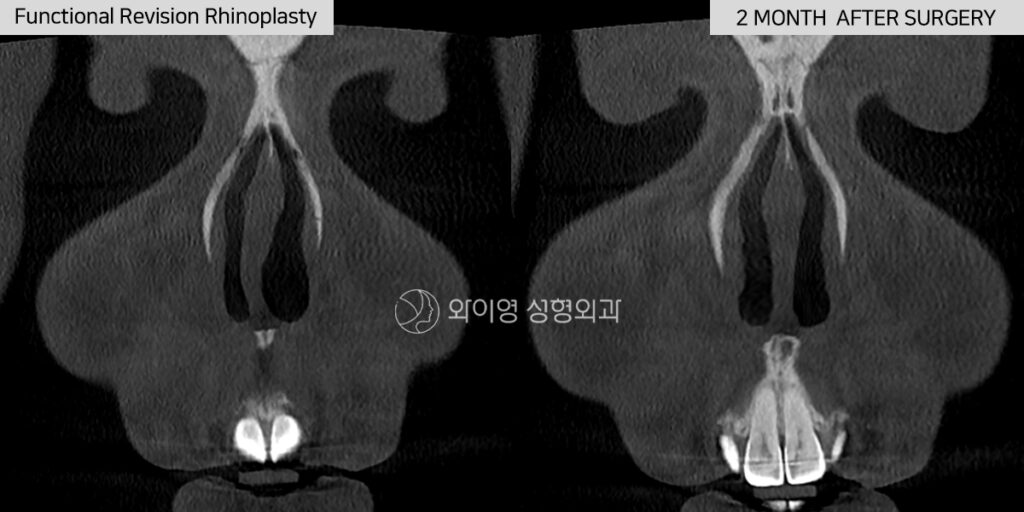
This case demonstrates how structural reconstruction improved both nasal function and appearance, with postoperative CT imaging confirming a stable result.
Understanding Breathing Problems and Septal Deviation After Rhinoplasty
This 27-year-old woman previously underwent rhinoplasty with a 5-mm silicone implant. Although the implant itself was not excessively large, it was placed without sufficient structural support beneath the nasal framework.
As healing progressed, the weakened support allowed the septum and nasal structures to shift gradually toward the right side. Over time, she developed noticeable nasal deviation and increasing difficulty breathing through her right nostril.
By the time she visited our clinic, her primary concerns included both nasal obstruction and the crooked appearance of her nose.
Why Functional Revision Rhinoplasty Is Different
Revision rhinoplasty performed for breathing problems requires a different approach than cosmetic revision alone.
Simply replacing an implant or straightening the external nose does not address the underlying cause if the internal framework remains unstable.
Long-term success depends on rebuilding the structural support of the nose so that both the airway and the external appearance remain stable over time.
For this reason, careful evaluation of the septum and supporting cartilage is one of the most important parts of functional revision surgery.
How We Performed Functional Revision Rhinoplasty
During surgery, the deviated septum was carefully repositioned and reinforced to restore a stable internal framework.
A silicone implant of similar height was placed on the nasal bridge because the patient was satisfied with her previous bridge height. Rather than increasing bridge projection, our goal was to rebuild the support beneath the implant.
The nasal tip was reconstructed to provide improved projection and a more refined contour while maintaining long-term structural stability.
At two months after surgery, postoperative CT imaging confirms that the septum remains well aligned and continues to provide excellent support.
Why Structural Support Is More Important Than Implant Size
Many patients believe that a crooked nose after rhinoplasty is caused by the silicone implant itself.
In reality, inadequate structural support is often the underlying reason why the nose gradually shifts over time.
Even a properly sized implant cannot remain stable if the supporting cartilage beneath it is weak.
By restoring the internal support system first, revision rhinoplasty can provide more reliable long-term cosmetic and functional results.
Frequently Asked Questions
Can rhinoplasty cause breathing problems?
Yes. If the septum or internal nasal support is weakened during surgery, some patients may gradually develop nasal obstruction after healing.
Why did my nose become crooked after rhinoplasty?
A crooked nose is often caused by insufficient structural support rather than the implant itself. As healing progresses, weakened cartilage may gradually shift, causing the nose to deviate.H3
Can revision rhinoplasty improve breathing?
Yes. Functional revision rhinoplasty aims to restore both nasal airflow and structural stability. Many patients experience significant improvement in breathing after correcting the underlying structural problem.
Why was another silicone implant used?
The previous implant height was appropriate for the patient’s facial proportions. The problem was not the implant itself but the lack of structural support beneath it. After rebuilding the internal framework, a silicone implant of similar height could be used safely.
Why is CT imaging helpful before and after revision surgery?
CT imaging allows surgeons to objectively evaluate the septum, internal nasal structures, and postoperative stability. It is especially valuable in patients with previous rhinoplasty and functional breathing problems.
Conclusion
Successful revision rhinoplasty is not simply about making the nose look straighter. Long-term stability begins with rebuilding the internal support system.
In this patient, functional revision rhinoplasty restored both nasal breathing and structural stability while maintaining a natural appearance. Postoperative CT imaging objectively confirms that the septum remains well aligned, providing a stable foundation for long-term results.
Related Articles
- Does a Crooked Nose After Rhinoplasty Always Need Revision Surgery?
- Why Does a Nose Become Crooked After Rhinoplasty?
- Crooked Nose Revision in Korea

