Introduction
One of the most serious complications after rhinoplasty is implant extrusion, where the silicone implant gradually erodes through the skin and becomes exposed.
Once this occurs, the surrounding soft tissue is often severely damaged, making reconstruction far more complex than a routine revision rhinoplasty.
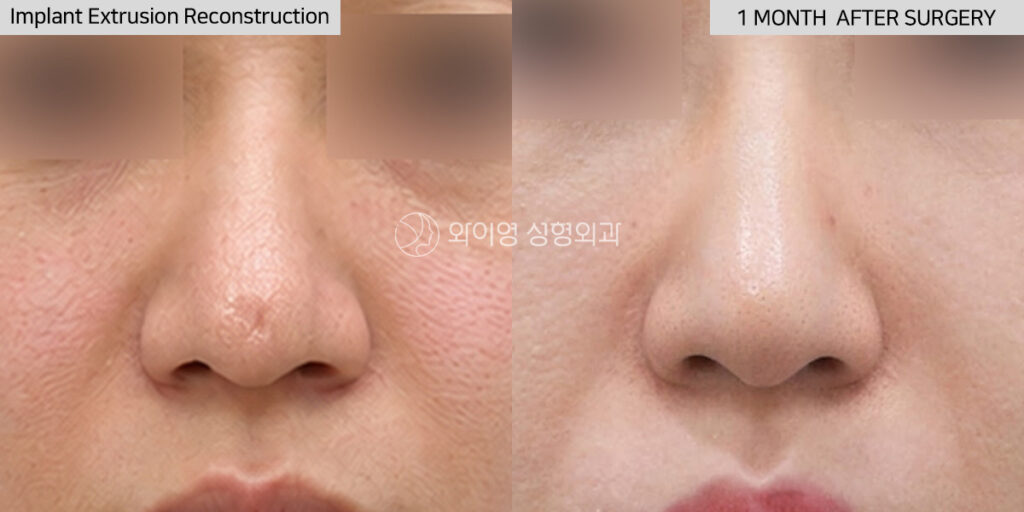
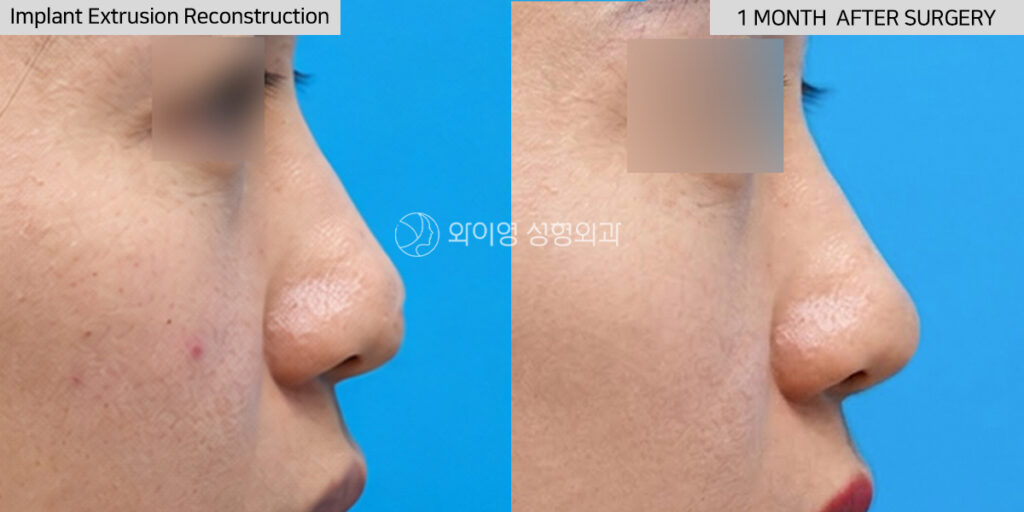
This case demonstrates how careful soft tissue preparation and structural reconstruction restored a nose that had experienced significant tissue loss following silicone implant extrusion.
Understanding Silicone Implant Extrusion
This 32-year-old woman experienced one of the most severe complications following rhinoplasty.
Three years earlier, the silicone implant gradually protruded through the skin of her nasal tip. Eventually, she removed the exposed implant herself.
Unfortunately, severe scar contracture developed afterward. The skin at the nasal tip became extremely thin and contracted, causing the tip to appear collapsed when viewed from the side.
By the time she visited our clinic, both the skin quality and the structural support of the nose had been significantly compromised.
Preparing the Skin Before Reconstruction
One of the biggest challenges was not rebuilding the cartilage—it was restoring the soft tissue.
Because the scar contracture was severe, immediate reconstruction carried a higher risk of wound healing problems.
Instead, the patient first underwent ten sessions of PDRN regenerative injections to improve the quality, flexibility, and vascularity of the contracted skin before surgery.
Only after the soft tissue became healthier was definitive reconstruction performed.
This staged approach helped create a safer environment for long-term healing.
Why We Chose Autologous Rib Cartilage
After experiencing implant extrusion, the patient no longer wished to receive another silicone implant.
Because healthy tissue had already been lost, autologous rib cartilage offered the safest and most reliable option for rebuilding both the nasal bridge and the nasal tip.
The rib cartilage provided strong structural support without introducing another permanent implant.
To further reinforce the area where the nasal tip skin had become particularly thin, rib perichondrium was used as an additional protective layer over the cartilage framework.
This extra layer helps improve soft tissue coverage while providing additional protection in high-risk reconstructive cases.
Why Soft Tissue Matters More Than the Implant
Many patients believe that reconstruction simply involves replacing the implant.
In reality, successful reconstruction depends far more on the condition of the surrounding soft tissue.
When the skin has become thin, scarred, or contracted, rebuilding the structural framework alone is often not enough.
Preparing the soft tissue, selecting appropriate graft materials, and protecting the reconstructed tip are equally important for achieving long-term stability.
Frequently Asked Questions
Can a silicone implant come through the skin?
Yes. Although uncommon, prolonged pressure, infection, or compromised blood supply can cause the implant to gradually erode through the nasal skin, resulting in implant extrusion.
Can a nose be reconstructed after implant extrusion?
Yes. Even after severe tissue damage, reconstruction is often possible. However, the quality of the remaining skin and scar tissue must be carefully evaluated before surgery.
Why was rib cartilage used instead of another implant?
Because the patient had already experienced a serious silicone implant complication, autologous rib cartilage provided a safer and more reliable long-term reconstructive option.
What is rib perichondrium and why was it used?
Rib perichondrium is the natural connective tissue that surrounds rib cartilage. In this case, it was used to reinforce the thinned nasal tip skin and provide additional soft tissue protection.
Can severely contracted skin recover before reconstruction?
In selected patients, improving the quality of the soft tissue before surgery may increase the safety of reconstruction. The appropriate treatment depends on each patient’s individual condition.
Conclusion
Successful reconstruction after silicone implant extrusion requires far more than replacing the missing implant.
In this patient, careful preparation of the scarred soft tissue, combined with autologous rib cartilage reconstruction and reinforcement using rib perichondrium, restored both structural stability and healthy soft tissue coverage.
Even in complex reconstructive cases, thoughtful surgical planning can achieve safe, stable, and natural long-term results.
Related Articles
- Silicone Implant vs Rib Cartilage for Dorsal Augmentation
- Rib Cartilage Rhinoplasty Without Implants
- Filler Necrosis Reconstruction with Rib Cartilage in Korea

